Россия, Пермский край ,Чердынский р-он,п.Ныроб


СДЕЛАЙТЕ СВОИ УРОКИ ЕЩЁ ЭФФЕКТИВНЕЕ, А ЖИЗНЬ СВОБОДНЕЕ
Благодаря готовым учебным материалам для работы в классе и дистанционно
Скидки до 50 % на комплекты
только до
Готовые ключевые этапы урока всегда будут у вас под рукой
Организационный момент
Проверка знаний
Объяснение материала
Закрепление изученного
Итоги урока

Была в сети 20.04.2026 12:01

Ясинская Валентина Николаевна
учитель английского ,немецкого языков
64 года
 1 119
1 119
 60 099
Местоположение
Специализация
Презентация "Цивилизация майя"
Категория:
Английский язык
29.10.2025 12:25

Просмотр содержимого документа
«Презентация "Цивилизация майя"»

Presentation on "the Mayan Civilization".

Mesoamerica or Middle America is a historical and cultural region stretching from the center of Mexico to Honduras and Nicaragua. The term was coined in 1943 by the German anthropologist Paul Kirchhoff.

The Mesoamerica was home to numerous advanced cultures and civilizations: the Aztecs, Mayas, the mixtecs and others.

It is a civilization known for their written language, art, architecture and mathematical and astronomical systems. Began to emerge in 2000 BC - 250 ad, Most of its cities reached its peak during the classic period (250 ad — 900 ad). Continued to exist until the arrival of the conquistadors.

Mayan writing has developed the most advanced writing system in all of pre-Columbian America. Inscriptions in the form of aerograph meet on stone, ceramics.

Architecture the Architecture of Maya is different from arches, inner arches, symmetrical and regular shapes, and a stylized outer trim.

Painting a Large part of Mayan painting was on the wall. Maya any paint bright colors outlined the contours of the figures and interior lines. Then paint was applied color. The paints were of mineral and vegetable origin. Gamut of paints was diverse: except white and black flowers. The main theme of the paintings-mass scenes of battles, celebrations.

Mayan books
Survived only 4 manuscripts of the Maya —"codes", which is folded like an accordion (pages) long strips of paper from the bark of ficus ("Indian paper"). With their help, priests interpreted the phenomena of nature and the actions of divine forces, conducted religious rituals. The codes were a matter of daily priestly practice and were placed in the grave after the owner's death.

Mayan city
More than 400 major Mayan cities and more than 4000 small towns were discovered. Each city was an independent part of the whole state. Maya cities were often at war with each other. Wars were conducted for the reasons: establishment of control over the territory, mastering trade routes.

The ancient city of Maya-Palenque Palenque is translated as "snake city". The official part of the city there are many buildings, which had great importance in the life of the Maya: the Pyramid of the Inscriptions, Palace, the temple of the Sun, Temple of the Count Temple of Skulls, the Temple of the cross, a field for ball games. Currently only 34 out of 500 found buildings have been excavated.

Chichen Itza is an ancient Mayan city Founded in the 7th century BC, covers an area of about 3 sq. km. the Main temple of the city - a 24-metre-high pyramid of Kukulkan. Sacred temple and the base is a square with side length of which is 55,5 m. To the top of the temple are wide stairs. 4 ladders on 91 steps on each. Only 364. And one step-on the top platform. And 365 days a year…

Tikal Tikal is the object that is included in the world heritage list of UNESCO. Its ruins include five large temples-pyramids, numerous tombs, graves and burials, and other structures. In total, there are about three thousand different structures.
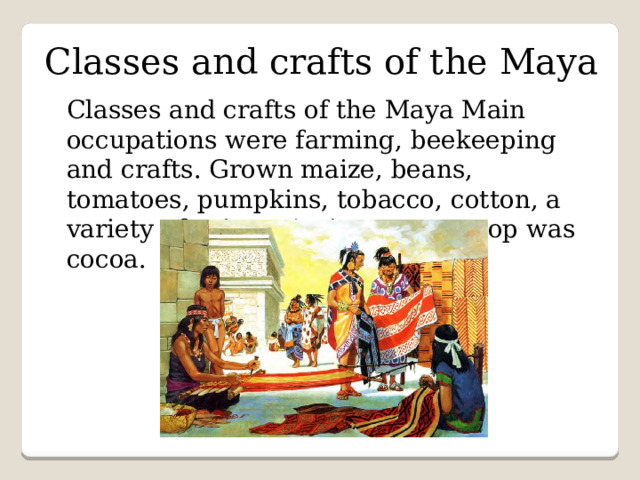
Classes and crafts of the Maya
Classes and crafts of the Maya Main occupations were farming, beekeeping and crafts. Grown maize, beans, tomatoes, pumpkins, tobacco, cotton, a variety of spices. An important crop was cocoa.

The mystery of the disappearance of the people the Question of where did the Mayans, continues to interest researchers. It is known that by the ninth century, the southern territory of residence of the Indians began to empty. The researchers call the following reasons: enemy attacks, bloody uprisings, epidemics and environmental catastrophe. Spanish fanaticism eradicated the culture and traditions of the Maya. Temples erected in honor of the gods were demolished. Their altars and statues are broken. All worship of them was forbidden under pain of severe punishment.
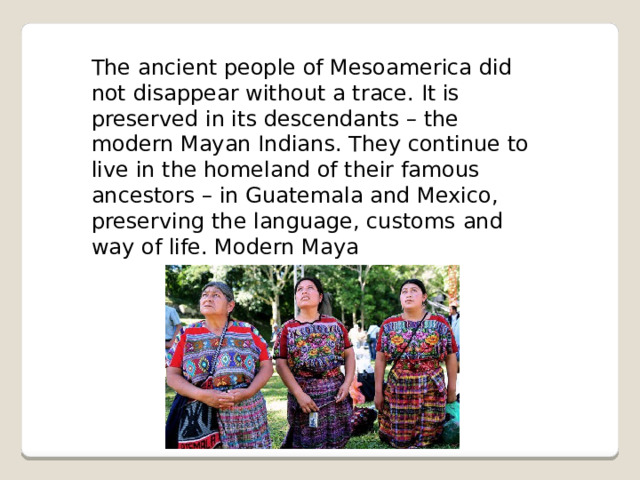
The ancient people of Mesoamerica did not disappear without a trace. It is preserved in its descendants – the modern Mayan Indians. They continue to live in the homeland of their famous ancestors – in Guatemala and Mexico, preserving the language, customs and way of life. Modern Maya








Вебинар для учителей

Свидетельство об участии БЕСПЛАТНО!