


Беларусь, Минск

СДЕЛАЙТЕ СВОИ УРОКИ ЕЩЁ ЭФФЕКТИВНЕЕ, А ЖИЗНЬ СВОБОДНЕЕ
Благодаря готовым учебным материалам для работы в классе и дистанционно
Скидки до 50 % на комплекты
только до
Готовые ключевые этапы урока всегда будут у вас под рукой
Организационный момент
Проверка знаний
Объяснение материала
Закрепление изученного
Итоги урока
Была в сети 03.06.2025 09:43

Садова Ольга Владимировна
учитель английского языка
 1 547
1 547
 45 698
Местоположение
Специализация
Презентация НПК
Категория:
Английский язык
26.04.2016 09:10

Просмотр содержимого документа
«Презентация НПК»

PHRASIOLOGICAL VERBS in the novel “The Clocks”
By Agatha Christie

OUR AIMS:
1- Compare two variants of the novel “The Clocks” – English and Russian edition
2- Analyze the usage of the phrasal verbs in English version and in Russian version
3- Find the differences in Russian and English phrasal verbs of the book “The Clocks”
4- Present our research in the additional booklet
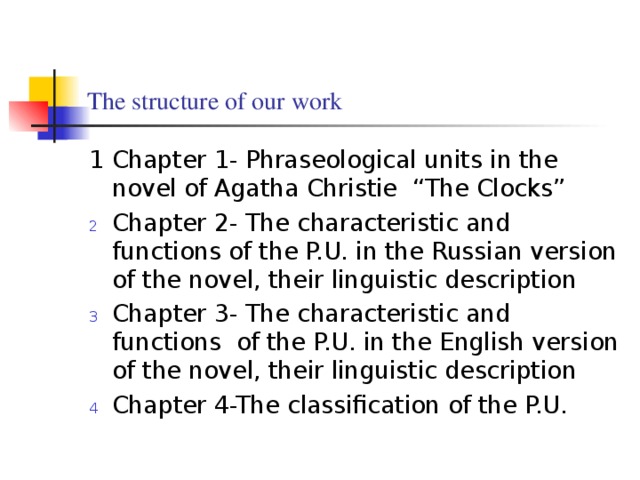
The structure of our work
1 Chapter 1- Phraseological units in the novel of Agatha Christie “The Clocks”
- Chapter 2- The characteristic and functions of the P.U. in the Russian version of the novel, their linguistic description
- Chapter 3- The characteristic and functions of the P.U. in the English version of the novel, their linguistic description
- Chapter 4-The classification of the P.U.

During our research the novel of Agatha Christie was carefully read and analyzed. We found and selected 200 phraseological units (just imagine such a fact!) then classified them according to two classifications and compare them with Russian version of the the novel.
- During our research the novel of Agatha Christie was carefully read and analyzed. We found and selected 200 phraseological units (just imagine such a fact!) then classified them according to two classifications and compare them with Russian version of the the novel.
- During our research the novel of Agatha Christie was carefully read and analyzed. We found and selected 200 phraseological units (just imagine such a fact!) then classified them according to two classifications and compare them with Russian version of the the novel.
- During our research the novel of Agatha Christie was carefully read and analyzed. We found and selected 200 phraseological units (just imagine such a fact!) then classified them according to two classifications and compare them with Russian version of the the novel.
- During our research the novel of Agatha Christie was carefully read and analyzed. We found and selected 200 phraseological units (just imagine such a fact!) then classified them according to two classifications and compare them with Russian version of the the novel.

OUR RESEARCH
- We analyzed the English edition of the novel and we tried to find the linguistic meaning of phraseological units and compare it with Russian variant. According to our research we made the conclusions:

THE RUSSIAN VARIANT
- 1- In Russian version of the novel there are a lot of constructions that have the phraseological structures- verb plus noun, adjective plus noun and the expressions with idiomatic sense .The neutrally-nominal function is the basic one for phraseological units, e.g. brown paper . In realization of such phrases in communication the fact of a designation of the object is important, and not the stylistic use of the phrase.

THE ENGLISH VARIANT
- The English variant of the novel The Clocks is full of the stylistic constructions idiomatisms and idiophraseomatisms, but they are not neutral, they are stylistically marked, e.g.: new broom, desperate remedies, tales out of school, crocodile tears.

THE CLOCKS
. We also analyzed the English edition of the novel and have a try to classify some phrasal verbs
1-- we chose the most popular and interesting phrasal verbs and collected them into different sense groups. This material can help readers to be well prepared for reading novels in origin.
2- Evidently, in texts of various types of Russian and English versions phraseological units carry out various functions - descriptive, characterizing, terminological and some others. Thus, all the functions described above are constant, i.e. presenting the norm of the language.

THE CLASSIFICATION OF THE ORIGING PHRASAL UNITS.
1- 1) phraseological combinations ( 54 units/ 27%) Bare-faced fortune hunting – бессовестная погоня за богатством
2) phraseological unities ( 66 units/ 33%) Go to pieces – остаться без ничего , e. g. : And if she goes to pieces, his neck’s in danger! (p. 99);
- 3) phraseological fusions ( 80units/ 40%) - word-groups with a completely changed meaning, they are demotivated, their meaning cannot be deduced from the meanings of the constituent parts, such as:
- Mare’s nest – иллюзия , e. g. : In my opinion the whole thing is a mare’s nest of Bauerstein’s! (p. 32);
Neck is in danger – быть в опасности , e. g. : And if she goes to pieces, his neck’s in danger! (p. 99);
3) phraseological fusions ( 80units/ 40%) Mare’s nest – иллюзия , e. g. : In my opinion the whole thing is a mare’s nest of Bauerstein’s! (p. 32);
The house that Jack built – рассказ с повторениями
To make up a cock and bull story – гадать , e. g. : Miss Howard has previously made up a cock and bull story about him and Mrs. Raikes to account for his holding his tongue afterwards. (p. 181);
To sail pretty near the wind - быть в шаге от нарушения закона , рисковать
As the crow flies – кротчайшим путем

So, we defined the phraseological units in which are mentioned
- 1. parts of the body, systems and functions of organism (28 units /14% ), for example :
- To play into smb.’s hands – играть на руку , e. g. : “However, your young naval friend played into my hands very nicely.” (p. 183);
- 2. weather phenomena ( 9 units/ 4,5 %):
- To get the wind up – заводиться , e. g. : “Moria and I began to get the wind up – I sometimes think unnecessarily” (p. 183);
- 3. names of animals, fish, birds ( 26 units/ 13 %):
- Red herring – отвлекающий маневр , e. g. : “We spotted the right man at the beginning and then, like idiots, we went astray after red herrings.” (p. 157);
- 4. sounds ( 10 units/5%):
- To go (off) with a bang – “ бабахнуть ”, e. g. : “The whole thing went with a bang. Moira cleared the money and went off ostensibly abroad – in reality back to Staverley and the Grange.” (p. 182);
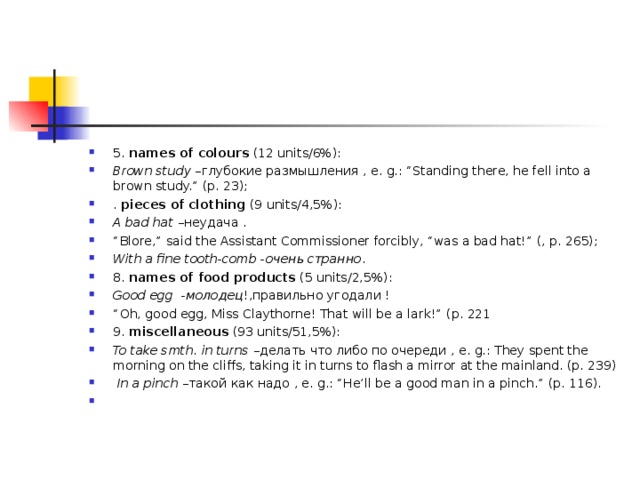
- 5. names of colours ( 12 units/6%):
- Brown study – глубокие размышления , e. g. : “Standing there, he fell into a brown study.” (p. 23);
- . piece s of clothing ( 9 units/ 4, 5%):
- A bad hat –неудача .
- “ Blore,” said the Assistant Commissioner forcibly, “was a bad hat!” (, p. 265);
- With a fine tooth-comb - очень странно .
- 8. names of food products ( 5 units/ 2, 5%):
- Good egg -молодец !,правильно угодали !
- “ Oh, good egg, Miss Claythorne! That will be a lark!” (p. 221
- 9. miscellaneous (93 units/51,5%):
- To take smth. in turns – делать что либо по очереди , e. g. : They spent the morning on the cliffs, taking it in turns to flash a mirror at the mainland. (p. 239)
- In a pinch – такой как надо , e. g. : “He’ll be a good man in a pinch.” (p. 116).
CONCLUSIONS
- We classify all the distinguished phraseological units into phraseological combinations, unities and fusions
- As a result, we came to the conclusion that phraseological fusions are used more frequently in Russian text than phraseological combinations and unities in English text . That can be explained by uniqueness of Agatha Christie style and her desire to make her detective novels more expressive, emotional, interesting and unusual for a reader.
- It was a kind of experiment to classify phraseological units of English version of the novel according to their thematic group.
- So, after conducting our research we sorted out the P.U. that can be very useful if you want to enrich your vocabulary
Вебинар для учителей

Свидетельство об участии БЕСПЛАТНО!



