Россия, Калуга


СДЕЛАЙТЕ СВОИ УРОКИ ЕЩЁ ЭФФЕКТИВНЕЕ, А ЖИЗНЬ СВОБОДНЕЕ
Благодаря готовым учебным материалам для работы в классе и дистанционно
Скидки до 50 % на комплекты
только до
Готовые ключевые этапы урока всегда будут у вас под рукой
Организационный момент
Проверка знаний
Объяснение материала
Закрепление изученного
Итоги урока

Была в сети 23.03.2026 21:02

Згонникова Алёна Александровна
учитель английского языка
58 лет
 738
738
 83 425
Местоположение
Специализация
Reported Speech
Категория:
Английский язык
11.03.2018 22:02

Просмотр содержимого документа
«Reported Speech»


Read and analyze the sentences
- Mike says to his little sister: "Kate, give me my book back."
- Mother says to her son, “Tom, don't open that box.“
- Mary says to her mother, "Mummy, buy me an ice-cream, please."
- Igor says to his friend, “Daniil, don't open the window, please."
- Mr Petrov says to his wife, "Please don't be late."

Indirect Speech.
При переводе прямой речи ( Reported Speech) в косвенную ( Indirect Speech) в английском языке происходит ряд изменений в употреблении форм времени глагола, а также в порядке слов.

Read and analyze the sentences
- Mum says: “I drink a cup of coffee every day.” Mum says that she drinks a cup of coffee every day.
- Dad says: “I’ve lost my voice.
Dad says that he’s lost his voice.
3. She says: “I will phone you tomorrow.”
She says that she’ll phone me tomorrow.
4. Mark says: “I went to a football match last night.”
Mark says that he went to a football match last night.

Remember.
- Если слова автора ( He says) в любом из настоящих времён, то при переводе прямой речи в косвенную речь время глагола сохраняется то же, что и в структуре с прямой речью.
Kate says: “I want to sleep.”- Kate says (that) she wants to sleep.

Read and analyze the sentences
- She said: “I know them.”
She said that she knew them.
- He said: “I saw it.”
He said that he had seen it.
- Jane said: “ I’ll do it.”
Jane said that she would do it.
4. The teacher said: “ You haven’t done the task.”
The teacher said that I hadn’t done the task.

Remember.
- Если слова автора в прошедшем времени ( He said) , то необходимо, чтобы в косвенной речи временной план был соотнесён с прошедшим временем.
Kate said: “ I went to the cinema last night.”-
Kate said that she had gone to the cinema the day before.

Remember
Direct Speech
Indirect Speech
Present Simple
Past Simple
Present Progressive
Past Progressive
Present Perfect
Past Simple
Past Perfect
Past Perfect
Past Perfect
Past Perfect
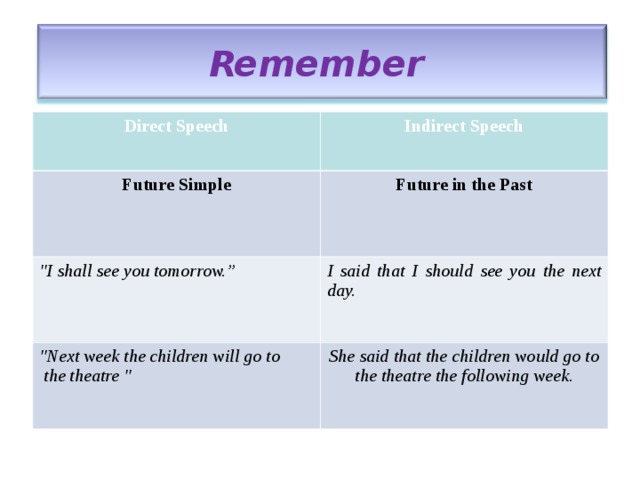
Remember
Direct Speech Indirect Speech
Direct Speech
Indirect Speech
Future Simple
Future in the Past
"I shall see you tomorrow.”
I said that I should see you the next day.
"Next week the children will go to
the theatre "
She said that the children would go to the theatre the following week.

Remember.
- Если слова автора в прошедшем времени, а в прямой речи употребляется форма будущего времени ( shall и will ), то в косвенной речи необходимо использовать глагол would.
He said, “We will meet on Monday.”- He said that they would meet on Monday.
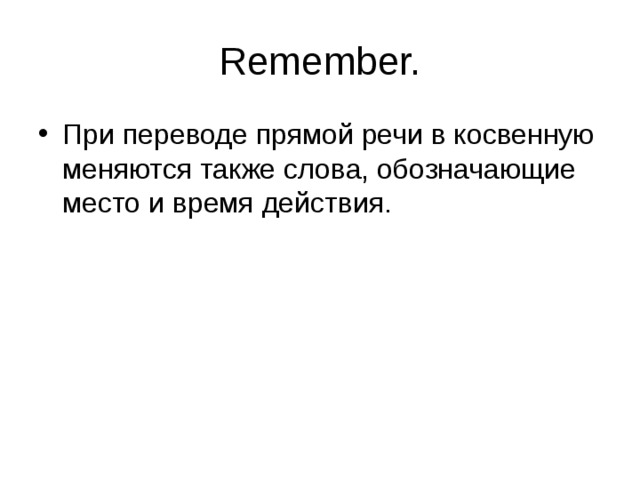
Remember.

Remember
tomorrow
the next day
the day after tomorrow
two days later
next week
the following week

Remember
this
that
these
those
these
those
here
there
now
then
today
that day

Remember.
- Модальные глаголы в этом случае также изменяются.
Sam said: “ You must reed it.”- Sam said that I had to reed it.

Remember
shall
should
will
would
can
could
may
might
must
Had to

Exercise.
- Do exercise 80 p.79 in your textbook.

Read and analyze the sentences
1. Peter says to his brother, "What are you looking for?"
Peter asks his brother what he is looking for.
2. Mrs Petrova says to her husband, "When will you go to the doctor's?"
Mrs Petrova asks her husband when he will go to the doctor's.
3. Aunt Nelly says to Vova, "Where have you been all this time?"
Aunt Nelly asks Vova where he has been all this time.
4. The teacher says to her class, "Who has pen-friends?"
The teacher asks the class who has pen-friends.
5. Robert says to his friend, "What interests you most of all?"
Robert asks Jim what interests him most of all.

Indirect Speech.
- В вопросительном предложении при переводе из прямой речи в косвенную меняется порядок слов – он напоминает порядок слов в повествовательном предложении. Глагол не в вопросительной форме – поэтому нет необходимости в употреблении вспомогательных глаголов.
He says, “Where is Jane?” – He asks where Jane is.

Indirect Speech.
- Для передачи в косвенной речи вопросов чаще всего используются следующие глаголы:
Ask, want to know, wonder.
“ Does your sister like jogging?”- She wanted to know if my sister liked jogging.

Indirect Speech.
- При изложении в косвенной речи общих вопросов используется один из названных глаголов с союзом if, при этом порядок слов в вопросе становится прямым ( как в повествовательном предложении).
“ Are you a good sportsman?” – She asked me if I was a good sportsman.
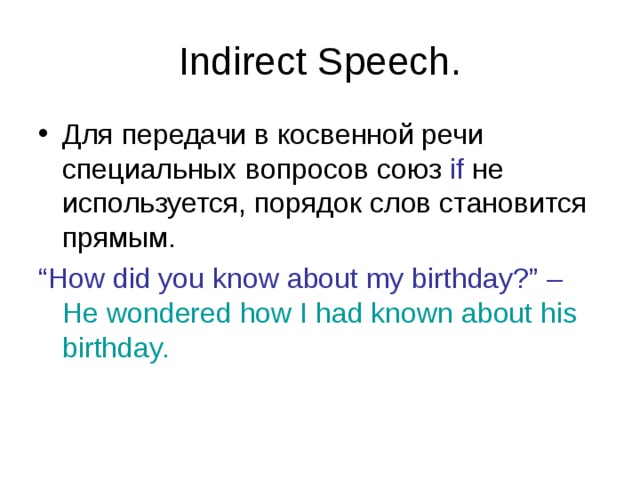
Indirect Speech.
- Для передачи в косвенной речи специальных вопросов союз if не используется, порядок слов становится прямым.
“ How did you know about my birthday?” – He wondered how I had known about his birthday.

Indirect Speech.
- Если слова автора в прошедшем времени, то форма времени глагола в вопросительном предложении в косвенной речи изменяется ( по правилу согласования времён).
He asked? “Where does she live?” – He asked where she lived .

Exercise1.
Read and change into indirect speech using the verb to ask in the Present Indefinite tense.
1. Daughter (to her parents): "Where shall we go for our holidays?"
2. Victor (to his friends): "What shall we do if Alec does not come in time?"
3. Teacher (to the schoolboy): "Why were you absent from the lesson?"
4. Mary (to Helen): "When did you send your New Year wishes?"
5. Man (to his family over the telephone): "What kind of weather are you having at the seaside?"
6. Boy (to the librarian): "Which novel is the most interesting?"
7. Ann (to Bess): "Who are you waiting for?"
8. Mrs Grass (to her husband): "When will you send the telegram to your brother, John?"
9. Mr Morris (to his wife): "Who has taken my magazine, I wonder?"
10. Woman (to the shop-assistant): "When will the shop open?"

Exercise2.
Read and tell your classmate what was said over the telephone
Tom: What shall we do tomorrow?
Harry: We'll go to the concert.
Kate: Will you take part in the competition next month?
Nelly: No, I shan't.
Alice: When will the concert begin?
Peter: It will begin at seven o'clock.
4. Robert: Where shall we meet?
William: We shall meet at the underground station.
Fred: Who will join our group?
Henry: My sister will?
George: Will you come to see us?
Peter: Yes, I shall.







Вебинар для учителей

Свидетельство об участии БЕСПЛАТНО!