© 2017, Doschanova Gulmira Bakidjanovna 361 1

СДЕЛАЙТЕ СВОИ УРОКИ ЕЩЁ ЭФФЕКТИВНЕЕ, А ЖИЗНЬ СВОБОДНЕЕ
Благодаря готовым учебным материалам для работы в классе и дистанционно
Скидки до 50 % на комплекты
только до
Готовые ключевые этапы урока всегда будут у вас под рукой
Организационный момент
Проверка знаний
Объяснение материала
Закрепление изученного
Итоги урока
Была в сети 24.05.2017 18:33

Doschanova Gulmira Bakidjanovna
Student bachelor
29 лет
 355
355
 130 370
Специализация
Result of the project
Категория:
Английский язык
20.05.2017 19:50

Просмотр содержимого документа
«Result of the project»
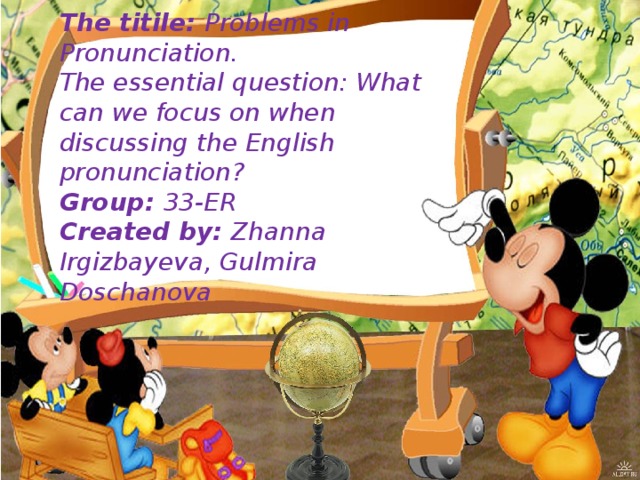
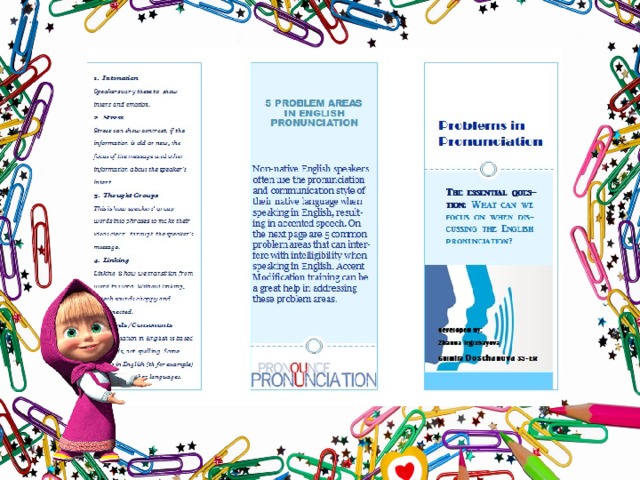
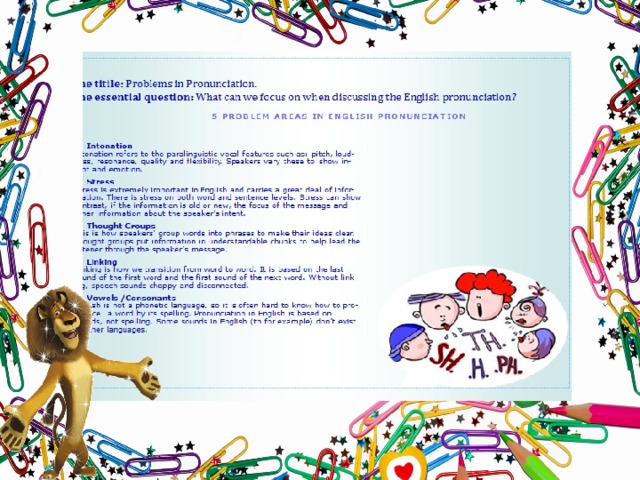
The titile: Problems in Pronunciation. The essential question: What can we focus on when discussing the English pronunciation? Group: 33-ER Created by: Zhanna Irgizbayeva, Gulmira Doschanova
1. Plan
2. Brochure
3. Poster
4. Gaming activities
Plan of the project
Preparing
Planning
Research
Result of the project
Preparing for protection of the project
Evaluation
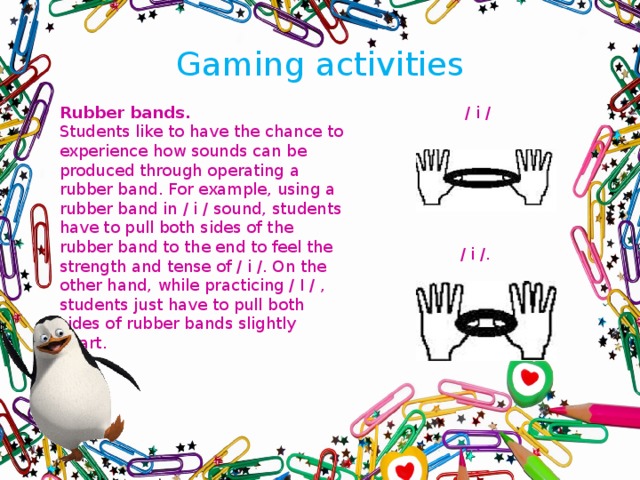
Gaming activities
Rubber bands.
/ i /
Students like to have the chance to experience how sounds can be produced through operating a rubber band. For example, using a rubber band in / i / sound, students have to pull both sides of the rubber band to the end to feel the strength and tense of / i /. On the other hand, while practicing / I / , students just have to pull both sides of rubber bands slightly apart.
/ i /.
By doing this, students can clearly distinguish the length of the two vowels and experience the real difference between both sounds. Other vowel sounds can also be demonstrated by rubber bands in the same way.
One important aspect that teachers have to inform students about vowels is that if the vowel sound follows a voiced consonant then the vowel sound will be pronounced a little bit longer than when followed by a voiceless consonant.
For example: Has he used this bet ? Has he used this bed ?
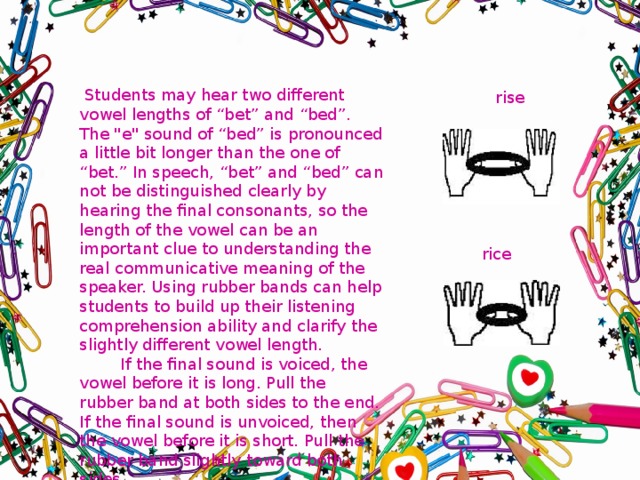
Students may hear two different vowel lengths of “bet” and “bed”. The "e" sound of “bed” is pronounced a little bit longer than the one of “bet.” In speech, “bet” and “bed” can not be distinguished clearly by hearing the final consonants, so the length of the vowel can be an important clue to understanding the real communicative meaning of the speaker. Using rubber bands can help students to build up their listening comprehension ability and clarify the slightly different vowel length.
If the final sound is voiced, the vowel before it is long. Pull the rubber band at both sides to the end. If the final sound is unvoiced, then the vowel before it is short. Pull the rubber band slightly toward both sides.
rise
rice
Practice the rubber band with different words within the same vowel but followed by voice and voiceless consonants, such as:
back bet cap plants cart sink ice bucks
bag bed cab plans card sing eyes bugs
Then, do some minimal pairs to practice these similar word sounds in sentences to reinforce the pronunciation. One student is speaking the sentence and the other is operating the rubber band according to what he/she heard from the partner. For example:
a. Please take this back. Please take this bag.
b. Has he used this bet? Has he used this bed?
c. I need a cap. I need a cab.
d. Where are your plants? Where are your plans?
e. Give him a cart. Give him a card.
f. She is going to sink. She is going to sing.
g. I wish I had blue ice. I wish I had blue eyes.
h. I found ten bucks. I found ten bugs.

Mirrors.
In addition to rubber bands, mirrors are a strong self-correction tool for students to modify or imitate sounds. Teachers can ask students to take out mirrors to do peer-correction or self-correction while approaching some problematic sounds.
Rhymes.
To avoid boring students with continuous practicing and drills, use rhymes with a regular beat and the same vowel sound. This will lead students to master the target sound unconsciously. For example, we take /e / sound into rhymes. Ask students to snap their fingers, clap, or tap on the desks to keep the beat and read aloud the rhyme:
Pretty birds don't fly away
Stay with me all the day
You can sing while I play
So, pretty birds don't fly away

Вебинар для учителей

Свидетельство об участии БЕСПЛАТНО!