Россия, Карелия Прионежский р-н с.Деревянное

СДЕЛАЙТЕ СВОИ УРОКИ ЕЩЁ ЭФФЕКТИВНЕЕ, А ЖИЗНЬ СВОБОДНЕЕ
Благодаря готовым учебным материалам для работы в классе и дистанционно
Скидки до 50 % на комплекты
только до
Готовые ключевые этапы урока всегда будут у вас под рукой
Организационный момент
Проверка знаний
Объяснение материала
Закрепление изученного
Итоги урока
Была в сети 20.03.2017 18:25
Алешина Татьяна Вадимовна
учитель английского языка
57 лет
 530
530
 103 187
Местоположение
Специализация
Родители и дети
Категория:
Английский язык
11.01.2017 12:02

Просмотр содержимого документа
«Родители и дети»
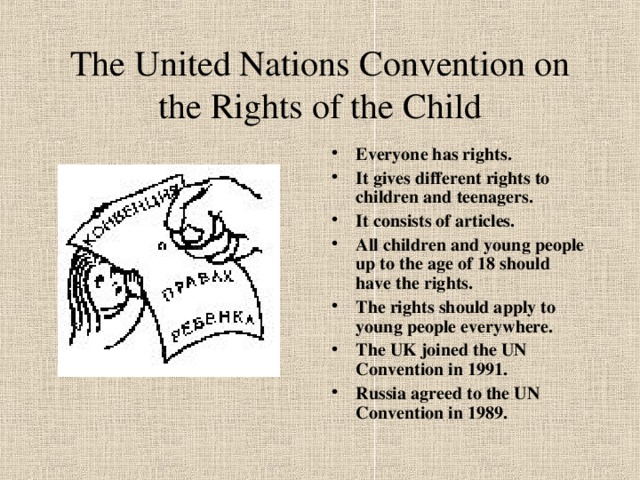
The United Nations Convention on the Rights of the Child
- Everyone has rights.
- It gives different rights to children and teenagers.
- It consists of articles.
- All children and young people up to the age of 18 should have the rights.
- The rights should apply to young people everywhere.
- The UK joined the UN Convention in 1991.
- Russia agreed to the UN Convention in 1989.
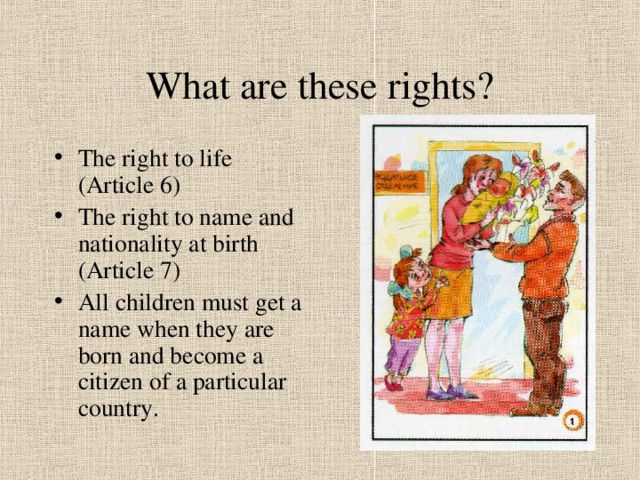
What are these rights?
- The right to life (Article 6)
- The right to name and nationality at birth (Article 7)
- All children must get a name when they are born and become a citizen of a particular country.
What are these rights?
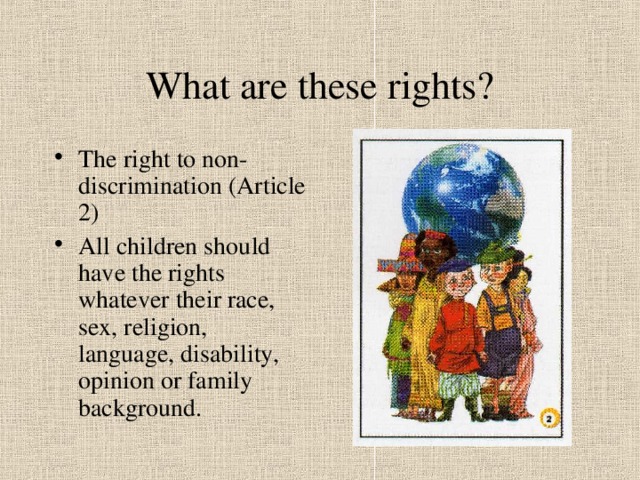
- The right to non-discrimination (Article 2)
- All children should have the rights whatever their race, sex, religion, language, disability, opinion or family background.
What are these rights?
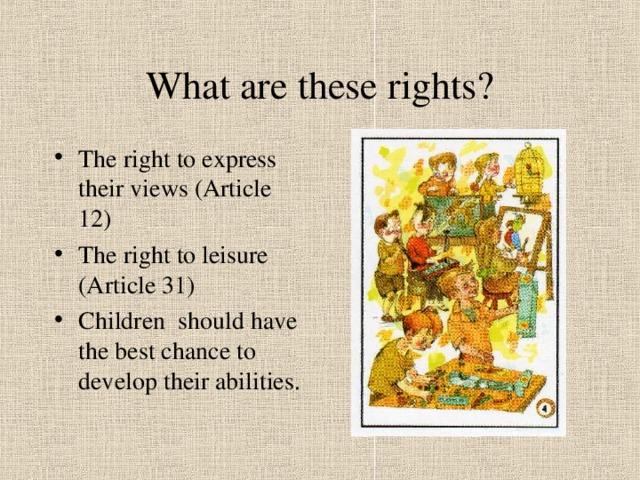
- The right to express their views (Article 12)
- The right to leisure (Article 31)
- Children should have the best chance to develop their abilities.
What are these rights?
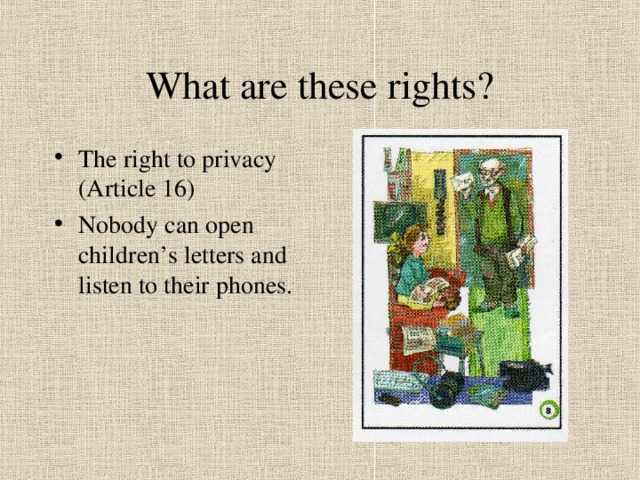
- The right to privacy (Article 16)
- Nobody can open children’s letters and listen to their phones.
What are these rights?
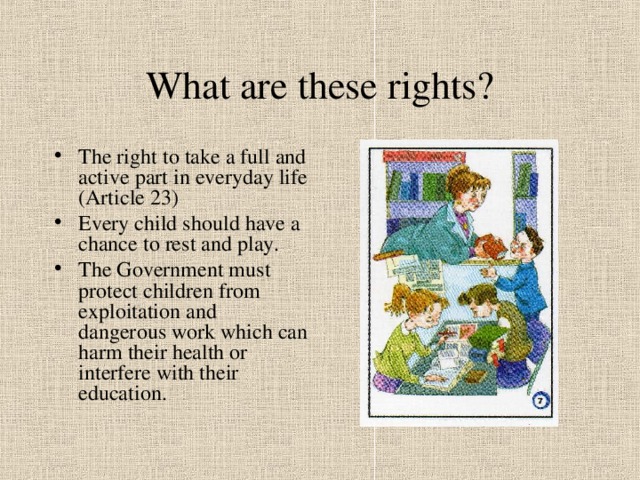
- The right to take a full and active part in everyday life (Article 23)
- Every child should have a chance to rest and play.
- The Government must protect children from exploitation and dangerous work which can harm their health or interfere with their education.
What are these rights?
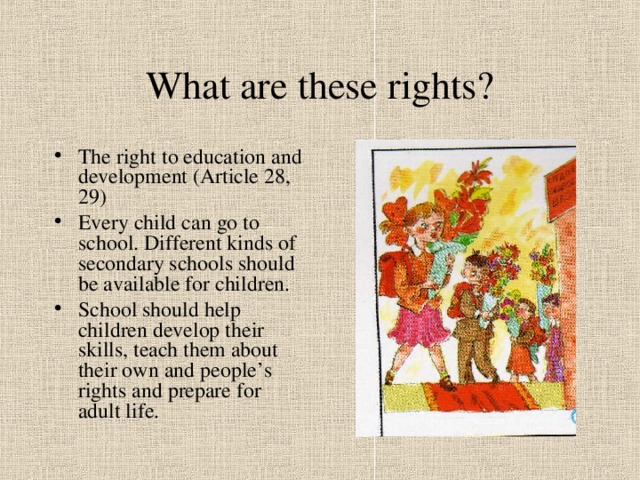
- The right to education and development (Article 28, 29)
- Every child can go to school. Different kinds of secondary schools should be available for children.
- School should help children develop their skills, teach them about their own and people’s rights and prepare for adult life.
What are these rights?
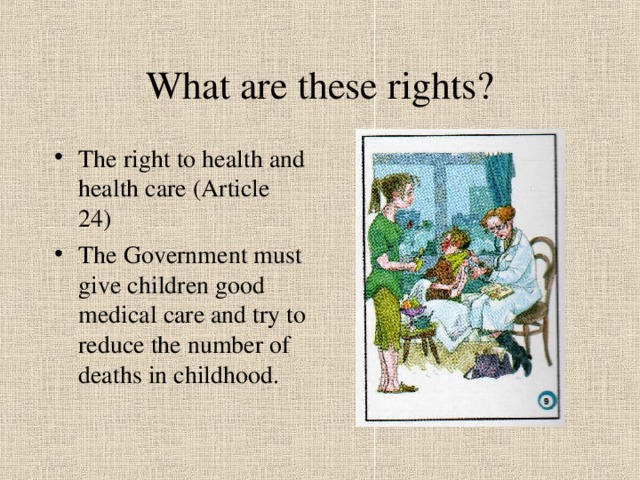
- The right to health and health care (Article 24)
- The Government must give children good medical care and try to reduce the number of deaths in childhood.
Review
Sometimes it happens that parents and their children cannot find the common language . It is often called “generation gap”. There can be different reasons for it. Parents can be too strict , they can criticize their children’s friends, studies, behaviour . Very often, they want their children to do more housework . Parents can be too busy with their own work and problems and therefore ignore the needs and interests of their children. But on the other hand, the children can care only about their own life and be indifferent to their parents. Some of them want to get and not to give. They don’t feel responsible for at all. This situation often leads to family conflicts .
What Are Your Parents Like?
- Do you get a lot of attention from your parents?
- Do they spoil you?
- What are your parents worried about?
- How much time do you spend together?
- What do you usually do?
- What questions do your parents often ask you?
- What are they interested in?
- What did your parents teach you to do?
- What do your parents never ask you about?
- How can you describe your parents and your relations with them?
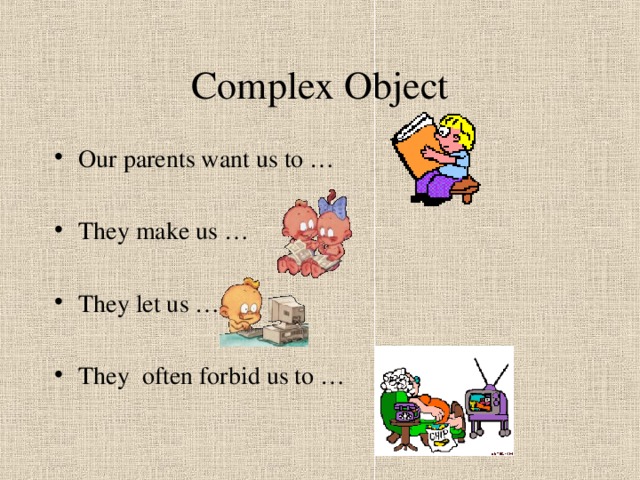
Complex Object
- Our parents want us to …
- They make us …
- They let us …
- They often forbid us to …
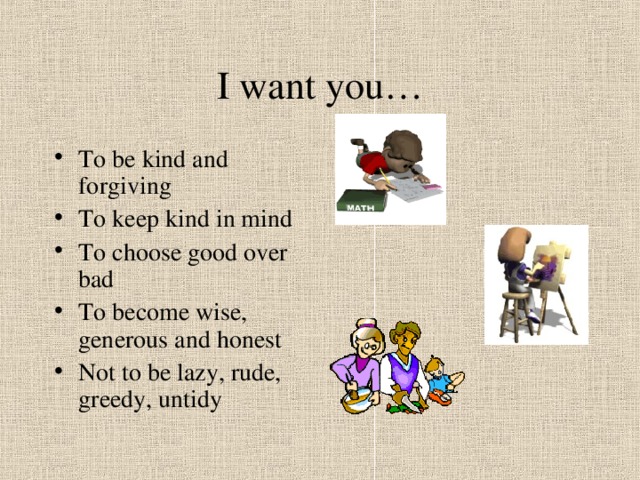
I want you…
- To be kind and forgiving
- To keep kind in mind
- To choose good over bad
- To become wise, generous and honest
- Not to be lazy, rude, greedy, untidy
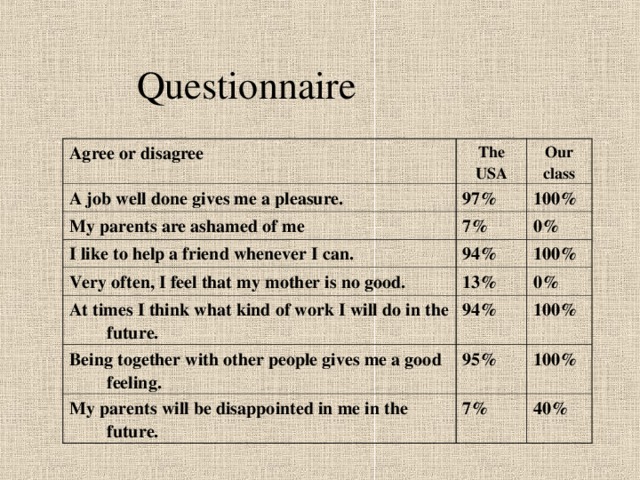
Questionnaire
Agree or disagree
The USA
A job well done gives me a pleasure.
Our class
97%
My parents are ashamed of me
7%
100%
I like to help a friend whenever I can.
0%
94%
Very often, I feel that my mother is no good.
13%
At times I think what kind of work I will do in the future.
100%
0%
94%
Being together with other people gives me a good feeling.
95%
100%
My parents will be disappointed in me in the future.
100%
7%
40%
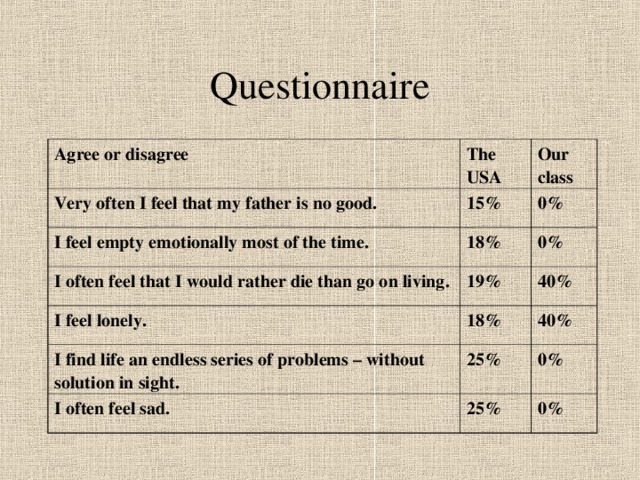
Questionnaire
Agree or disagree
The USA
Very often I feel that my father is no good.
Our class
15%
I feel empty emotionally most of the time.
18%
0%
I often feel that I would rather die than go on living.
I feel lonely.
19%
0%
18%
40%
I find life an endless series of problems – without solution in sight.
40%
25%
I often feel sad.
25%
0%
0%
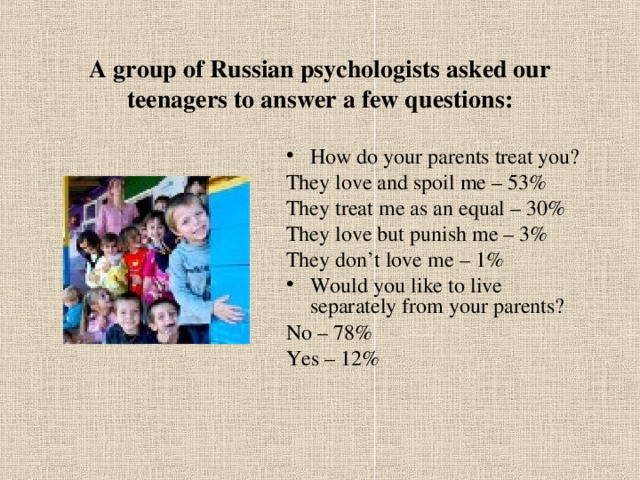
A group of Russian psychologists asked our teenagers to answer a few questions:
- How do your parents treat you?
They love and spoil me – 53%
They treat me as an equal – 30%
They love but punish me – 3%
They don’t love me – 1%
- Would you like to live separately from your parents?
No – 78%
Yes – 12%
“ Don’t Bother Me Now, I’m Too Busy” (by Michaelle Jones)
“ Mommy, why do trees grow?”
“ Don’t bother me now, I’m too busy.”
“ Mommy, why is grass green?”
“ Don’t bother me now, I’m too busy.”
“ Daddy, what are you doing?”
“ Don’t bother me now, I’m too busy.”
“ Mom, can I go to the movies?”
“ Don’t bother me now, I’m too busy.”
“ Dad, when can I drive?”
“ Don’t bother me now, I’m too busy.”
“ Mom, what is love?”
“ Don’t bother me now, I’m too busy.”
“ Sir, we arrested your son on drug charges.”
“ Don’t bother me now, I’m too busy.”
“ Mom and Dad, I tried to find my own answers”.
“ Don’t bother me now, I’m too busy.”
“ Mom and Dad, don’t you love me?”
“ Don’t bother me now, I’m too busy.”
Words of Wisdom
- Kindness gives birth to kindness (Sophocles)
- The man who makes no mistakes does not usually make anything (Edward John Phelps)
- Whatever you cannot understand, you cannot possess (Goethe)
- It is never too late to mend (Proverb)
- Children are born to be happy (Jose Marti)
- Kind words can be short and easy to speak, but their echoes are truly endless (Mother Theresa)
- The more we do, the more we can do (Hazlitt)
- Be moral in every dead and in every thought (Longfellow)
- All happy families are alike, but each unhappy family is unhappy in its own way (Leo Tolstoy)
Acrostics
- P arents should be patient with their kids
- A nd we’ll be more friendly and cheerful.
- R elations will be warmer and kinder.
- E ducation isn’t easy thing at all!
- N obody could understand the whole world.
- T ry to live in peace and love together.
- S ave the children from troubles and love them!
Acrostics
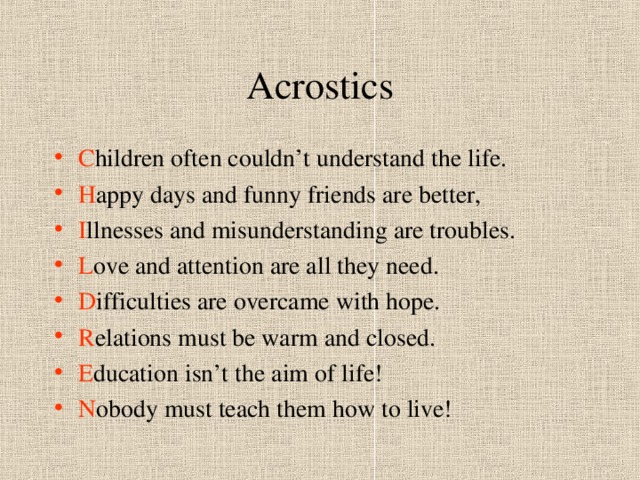
- C hildren often couldn’t understand the life.
- H appy days and funny friends are better,
- I llnesses and misunderstanding are troubles.
- L ove and attention are all they need.
- D ifficulties are overcame with hope.
- R elations must be warm and closed.
- E ducation isn’t the aim of life!
- N obody must teach them how to live!
Live with love!
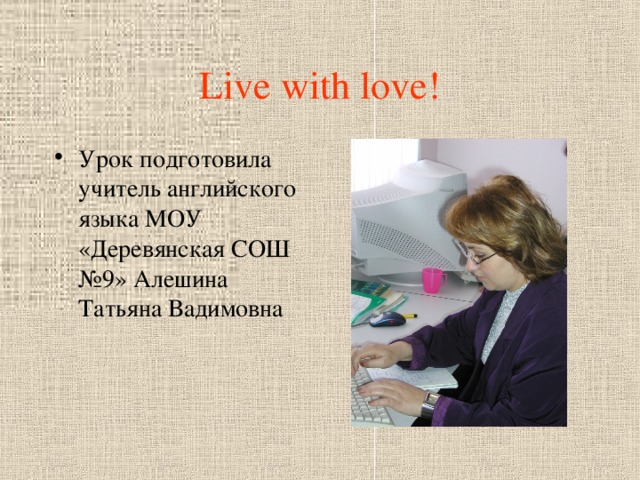
- Урок подготовила учитель английского языка МОУ «Деревянская СОШ №9» Алешина Татьяна Вадимовна

Вебинар для учителей
Свидетельство об участии БЕСПЛАТНО!