

Россия, Екатеринбург

СДЕЛАЙТЕ СВОИ УРОКИ ЕЩЁ ЭФФЕКТИВНЕЕ, А ЖИЗНЬ СВОБОДНЕЕ
Благодаря готовым учебным материалам для работы в классе и дистанционно
Скидки до 50 % на комплекты
только до
Готовые ключевые этапы урока всегда будут у вас под рукой
Организационный момент
Проверка знаний
Объяснение материала
Закрепление изученного
Итоги урока
Была в сети 05.06.2026 18:24

Тигранян Астхик Ишхановна
педагог дополнительного образования
43 года
 1 422
1 422
 49 350
Местоположение
Специализация
Transport in Great Britain
Категория:
Английский язык
13.01.2021 07:11

Просмотр содержимого документа
«Transport in Great Britain»

What are the most popular modes of transport in GB?
- What transport did Britain pioneer?
- How different are their buses and coaches from ours?
- What is the Tube?
- How can you get to Europe (France, Belgium)?
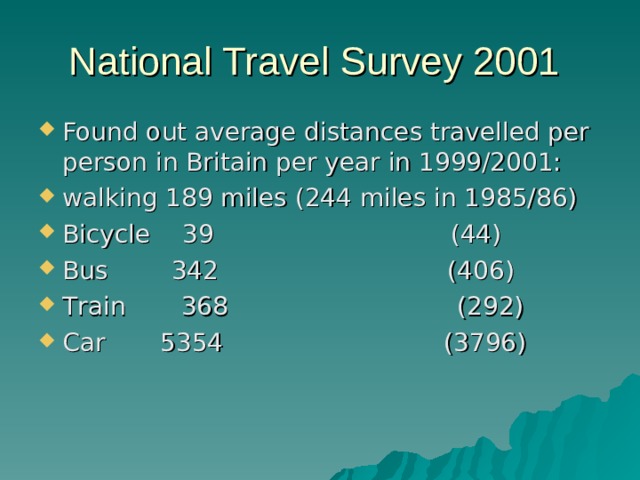
National Travel Survey 2001
- Found out average distances travelled per person in Britain per year in 1999/2001:
- walking 189 miles (244 miles in 1985/86)
- Bicycle 39 (44)
- B us 342 (406)
- T rain 368 (292)
- Car 5354 (3796)

Cars
- Most people in Britain travel by car. About 75% of households have at least one car.

Bicycles
- Bicycles as well as walking are popular . More and more people think about clean environment, good physical exercise
- They save money on petrol and parking and escape losing time in congestions.
- Besides they have special bicycle “parking lots”- metal bars to chain or lock your bikes to.
Motorcycles
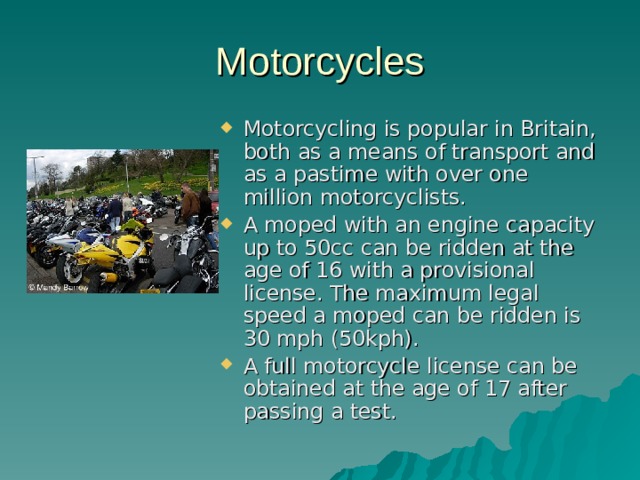
- Motorcycling is popular in Britain, both as a means of transport and as a pastime with over one million motorcyclists.
- A moped with an engine capacity up to 50cc can be ridden at the age of 16 with a provisional license. The maximum legal speed a moped can be ridden is 30 mph (50kph).
- A full motorcycle license can be obtained at the age of 17 after passing a test.

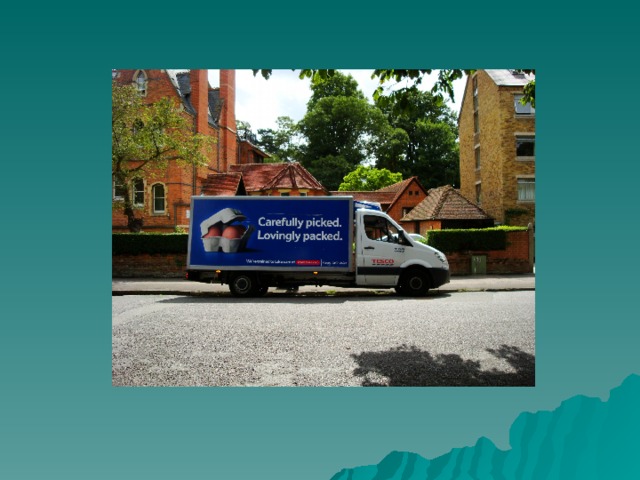
Lorries
- Most goods are transported by roads in lorries
- At the beginning of the 20th century, railway trains and canal barges were the main means of transporting heavy goods. Now around 65% are carried by lorries.
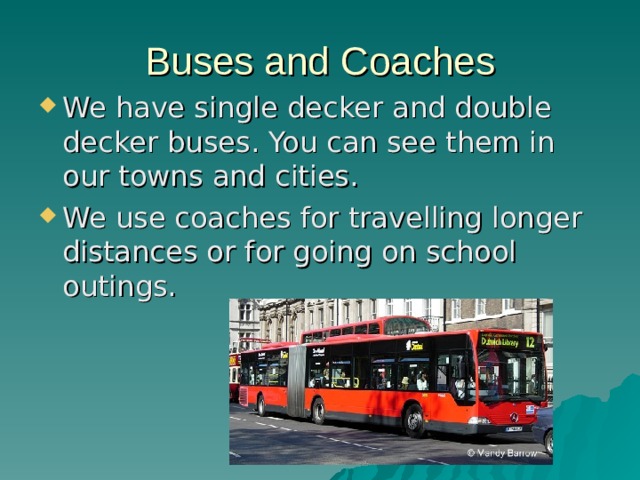
Buses and Coaches
- We have single decker and double decker buses. You can see them in our towns and cities.
- We use coaches for travelling longer distances or for going on school outings.
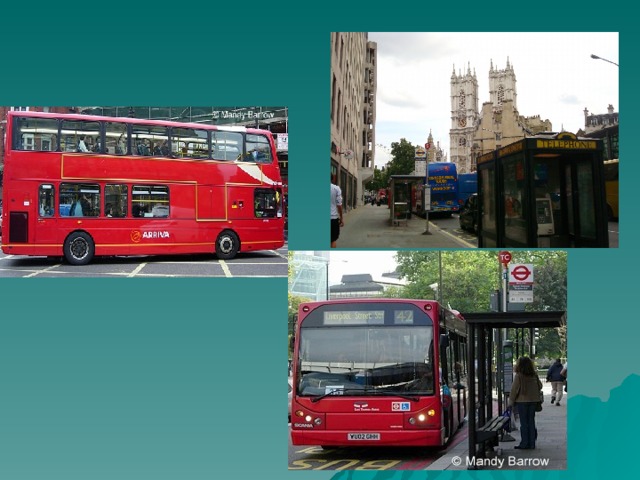
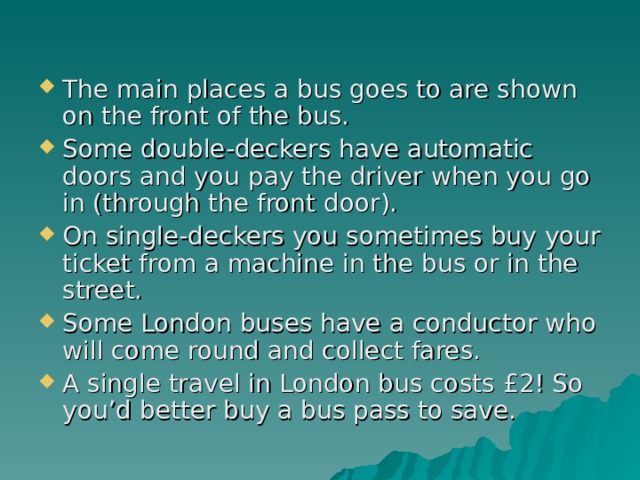
- The main places a bus goes to are shown on the front of the bus.
- Some double-deckers have automatic doors and you pay the driver when you go in (through the front door).
- On single-deckers you sometimes buy your ticket from a machine in the bus or in the street.
- Some London buses have a conductor who will come round and collect fares.
- A single travel in London bus costs £2! So you’d better buy a bus pass to save.

Sightseeing buses
- There are many sightseeing, open top, buses in London and other cities.
- They provide hop-on hop-off service: you buy a tour valid for 24 hours and travel around the city getting off at any sight and walking on your own. Then you get on another bus and keep on riding. The bus stops, sights and a short description is given in your map.
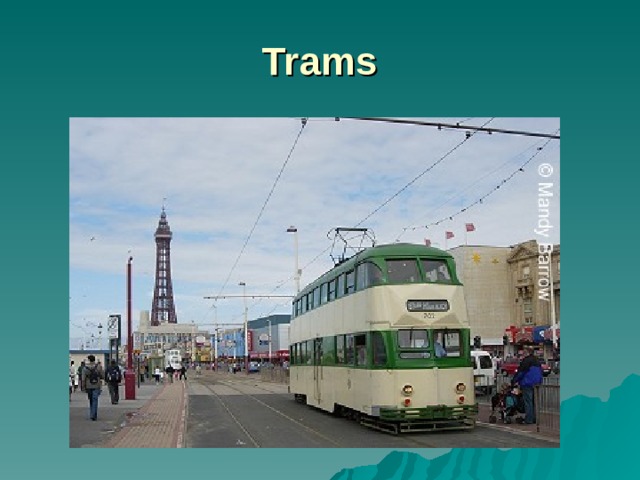
Trams

Taxis
- In London , the taxis are black but in the rest of the country they are different colours.
- Black Cabs are the only taxi you can hail from the street (though they now come in other colours as well). With the "for hire" sign lit, the driver is obliged to stop for you.

Trains
- The rail network in Britain is one of the most extensive in Europe with over 11,000 miles (17,500km) of lines, some 2,500 stations and around 1,500 trains a day
Britain pioneered railways.
The Stockton and Darlington railway (1825) was the first public passenger railway in the world.

The Tube
The London underground railway system (or 'tube') celebrated its centenary in 1990 and is internationally famous, ranking alongside the Paris metro and the New York subway. London's tube network covers the largest
area of any underground
rail system, with 253miles
of tracks,of which 20miles
are in shallow tunnels
and 93 miles in deep
tunnels. The tube runs
to all areas of central
and greater London,
connecting
all mainline stations.

- London was the first city in the world to have an underground railway, called the 'tube'. The first line was built in 1890.


Euro Trains
- The trains travel under the sea in a very long tunnel called the Channel Tunnel. The tunnel was completed in 1995 and is 50 metres below the sea bed.
- Eurostar is the high-speed train service linking London, Ashford, Paris, Brussels, Lille, Avignon, Calais, Disneyland Resort Paris and the French Alps.

- Journey Times
- London to Paris - 2 hours 15 mins London to Brussels - 1hr 51 mins London to Lille - 1hr 20 mins
- Eurostar only transports people, if you would like to take you car you have to go on the Euro Shuttle.
- The "Shuttle" service joins Calais to Folkestone in 35 minutes. We drive our cars onto the Shuttle trains.
Airports
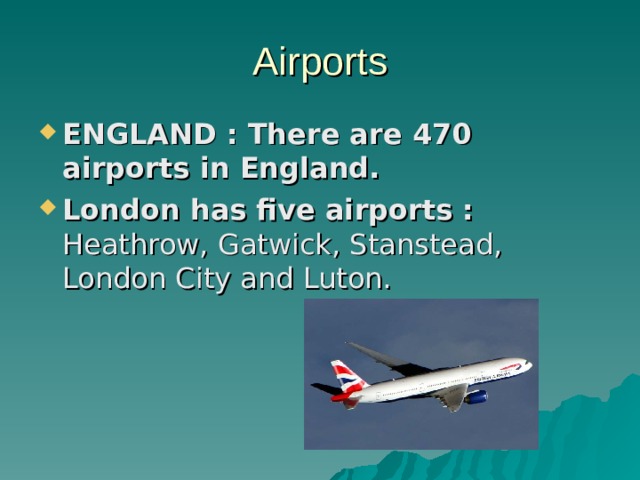
- ENGLAND : There are 470 airports in England.
- London has five airports : Heathrow, Gatwick, Stanstead, London City and Luton.

- Heathrow, Gatwick, Stanstead have underground connections to the centre of London and are the main London airports.
- Heathrow and Gatwick Airports are the two main centres for overseas flights.
- London (Heathrow)
- Airport is one
- of the largest
- airports in the
- world and has
- two tube
- stations.
- The number of passengers arriving and departing to or from London's airports equalled over 120 million in 2004. Heathrow handled 67m passengers, making the airport the busiest and best connected in the world.
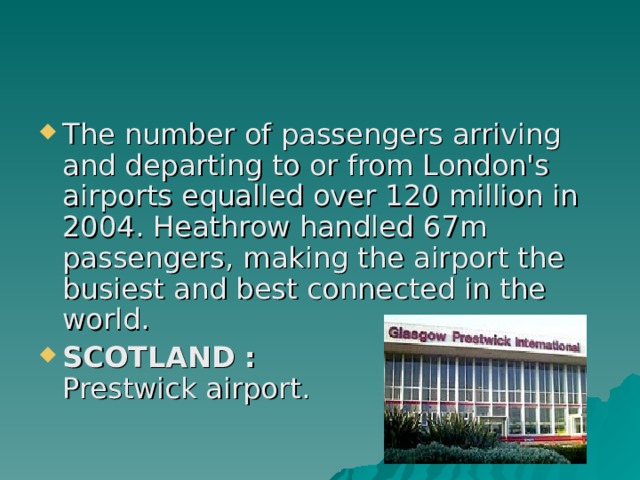
- SCOTLAND : Prestwick airport.
Ships
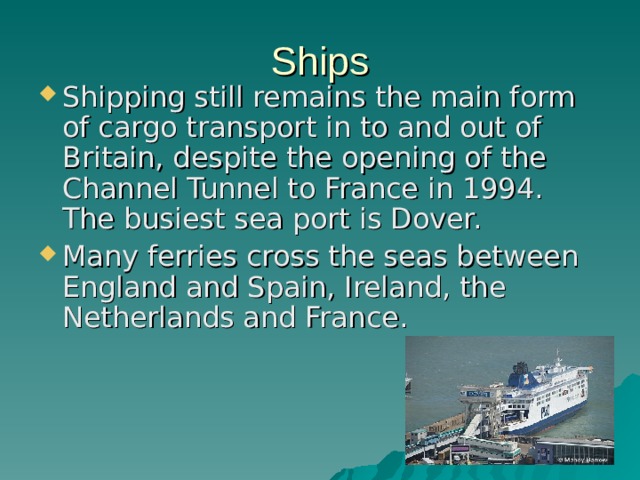
- Shipping still remains the main form of cargo transport in to and out of Britain, despite the opening of the Channel Tunnel to France in 1994. The busiest sea port is Dover.
- Many ferries cross the seas between England and Spain, Ireland, the Netherlands and France.

Ferry crossings from England to Ireland, France, Isle of Wight and Holland
- Dover to Calais Once an hour - Crossing time 75min
- Portsmouth to Le Havre Once a day - Crossing time 5 to 8 hours
- Portsmouth to Cherbourg Once a day - Crossing time 7 to 10 hours
- Hull to Rotterdam Once a day - Crossing time 10 hours
- Hull to Zeebrugge Once a day - Crossing time 15 hours
- Liverpool to Dublin Twice a day - Crossing time 8 hours
- Southampton to Isle of Wight Once an hour - Crossing time 1 hour
- Swansea to Cork Once a day - Crossing time 10 hours






Вебинар для учителей

Свидетельство об участии БЕСПЛАТНО!



