Россия, Москва

СДЕЛАЙТЕ СВОИ УРОКИ ЕЩЁ ЭФФЕКТИВНЕЕ, А ЖИЗНЬ СВОБОДНЕЕ
Благодаря готовым учебным материалам для работы в классе и дистанционно
Скидки до 50 % на комплекты
только до
Готовые ключевые этапы урока всегда будут у вас под рукой
Организационный момент
Проверка знаний
Объяснение материала
Закрепление изученного
Итоги урока
Была в сети 16.05.2026 14:10

Мошкина Татьяна Анатольевна
Учитель английского языка.
 5 085
5 085
 12 214
Местоположение
Специализация
Удивительные названия московских улиц.
Категория:
Английский язык
13.05.2026 23:15

Просмотр содержимого документа
«Удивительные названия московских улиц.»
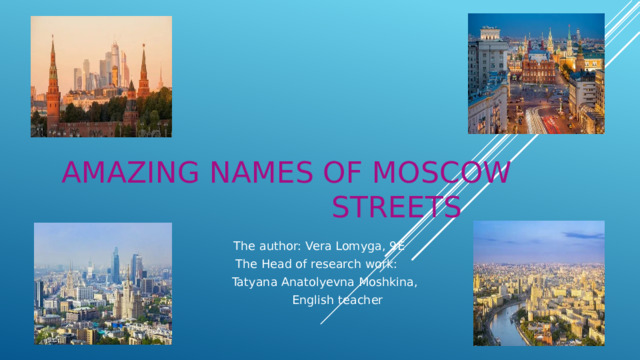
AMAZING NAMES OF MOSCOW STREETS
The author: Vera Lomyga, 9E
The Head of research work:
Tatyana Anatolyevna Moshkina,
English teacher
- Moscow is the capital of the Russian Federation, a huge beautiful metropolis, whose history is reflected in the present appearance of the city. Striving to get to know the city more deeply, we come into contact with the most interesting pages of its history and consider this research important and relevant for us.
- This research is important, as it allows:
- 1. To get better acquainted with the toponymy of Moscow streets;
- 2. To consider important pages in the history of the city;
- 3. To expand horizons and gain new knowledge on this topic.
RELEVANCE OF THE RESEARCH
- The purpose of the study: to study how physical and geographical phenomena and historical events influenced the names of Moscow streets. And also to reveal the special uniqueness of the great ancient city.
- Research objectives:
- 1. To establish how physical and geographical realities influenced toponymic names within the city.
- 2. To find out what historical events influenced the names of city streets;
- 3. To collect material on the topic of the research work and summarize it.
- 4. To format the material and make a presentation.
- 5. To publish a booklet.
PURPOSE AND OBJECTIVES OF THE RESEARCH
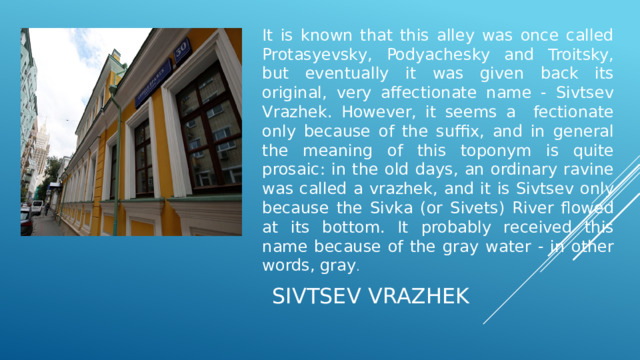
It is known that this alley was once called Protasyevsky, Podyachesky and Troitsky, but eventually it was given back its original, very affectionate name - Sivtsev Vrazhek. However, it seems a fectionate only because of the suffix, and in general the meaning of this toponym is quite prosaic: in the old days, an ordinary ravine was called a vrazhek, and it is Sivtsev only because the Sivka (or Sivets) River flowed at its bottom. It probably received this name because of the gray water - in other words, gray .
SIVTSEV VRAZHEK
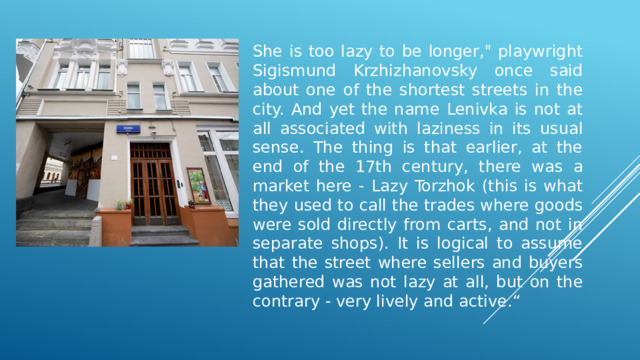
She is too lazy to be longer," playwright Sigismund Krzhizhanovsky once said about one of the shortest streets in the city. And yet the name Lenivka is not at all associated with laziness in its usual sense. The thing is that earlier, at the end of the 17th century, there was a market here - Lazy Torzhok (this is what they used to call the trades where goods were sold directly from carts, and not in separate shops). It is logical to assume that the street where sellers and buyers gathered was not lazy at all, but on the contrary - very lively and active.“
LENIVKA STRSST
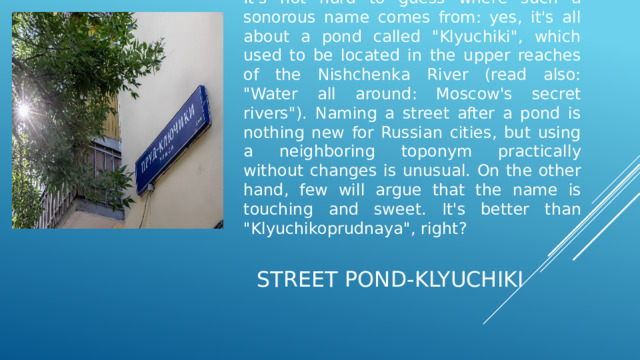
- It's not hard to guess where such a sonorous name comes from: yes, it's all about a pond called "Klyuchiki", which used to be located in the upper reaches of the Nishchenka River (read also: "Water all around: Moscow's secret rivers"). Naming a street after a pond is nothing new for Russian cities, but using a neighboring toponym practically without changes is unusual. On the other hand, few will argue that the name is touching and sweet. It's better than "Klyuchikoprudnaya", right?
Street Pond-Klyuchiki
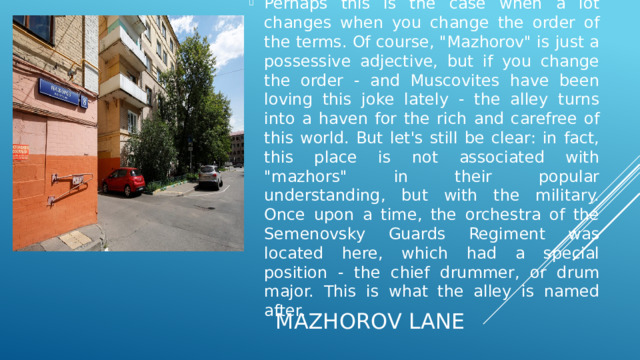
- Perhaps this is the case when a lot changes when you change the order of the terms. Of course, "Mazhorov" is just a possessive adjective, but if you change the order - and Muscovites have been loving this joke lately - the alley turns into a haven for the rich and carefree of this world. But let's still be clear: in fact, this place is not associated with "mazhors" in their popular understanding, but with the military. Once upon a time, the orchestra of the Semenovsky Guards Regiment was located here, which had a special position - the chief drummer, or drum major. This is what the alley is named after.
Mazhorov Lane
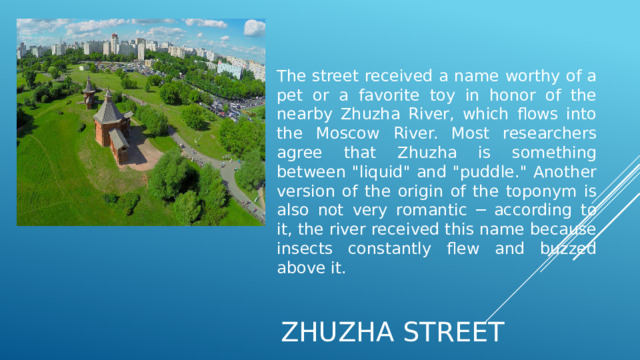
The street received a name worthy of a pet or a favorite toy in honor of the nearby Zhuzha River, which flows into the Moscow River. Most researchers agree that Zhuzha is something between "liquid" and "puddle." Another version of the origin of the toponym is also not very romantic ─ according to it, the river received this name because insects constantly flew and buzzed above it.
ZHUZHA STREET
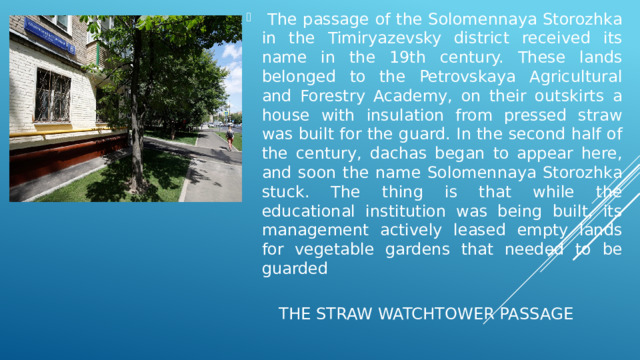
- The passage of the Solomennaya Storozhka in the Timiryazevsky district received its name in the 19th century. These lands belonged to the Petrovskaya Agricultural and Forestry Academy, on their outskirts a house with insulation from pressed straw was built for the guard. In the second half of the century, dachas began to appear here, and soon the name Solomennaya Storozhka stuck. The thing is that while the educational institution was being built, its management actively leased empty lands for vegetable gardens that needed to be guarded
The Straw Watchtower Passage
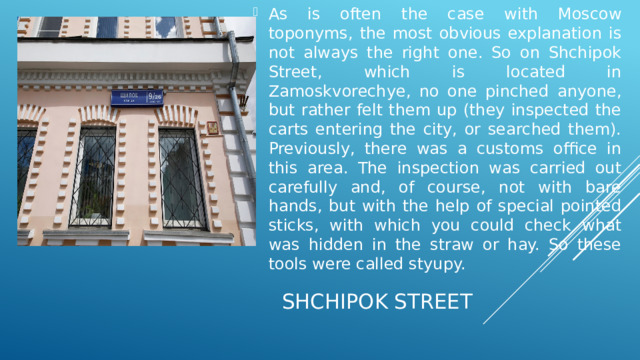
- As is often the case with Moscow toponyms, the most obvious explanation is not always the right one. So on Shchipok Street, which is located in Zamoskvorechye, no one pinched anyone, but rather felt them up (they inspected the carts entering the city, or searched them). Previously, there was a customs office in this area. The inspection was carried out carefully and, of course, not with bare hands, but with the help of special pointed sticks, with which you could check what was hidden in the straw or hay. So these tools were called styupy.
Shchipok Street
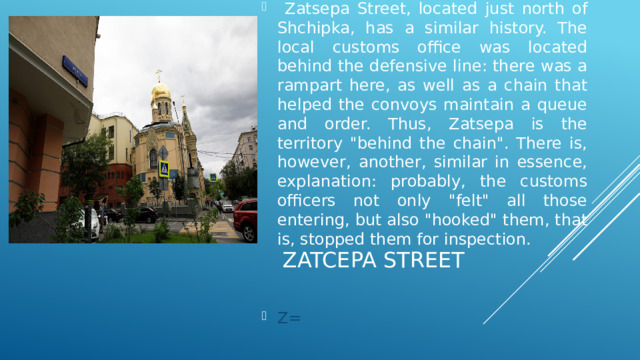
- Zatsepa Street, located just north of Shchipka, has a similar history. The local customs office was located behind the defensive line: there was a rampart here, as well as a chain that helped the convoys maintain a queue and order. Thus, Zatsepa is the territory "behind the chain". There is, however, another, similar in essence, explanation: probably, the customs officers not only "felt" all those entering, but also "hooked" them, that is, stopped them for inspection.
- Z=
Zatcepa Street
- The important feature of all geographical names, their characteristic feature is the historicity of toponyms. The names of streets, squares, lanes, boulevards of the capital are a kind of historical monuments, which reflect the social relations of the eras that preceded us, the features of ethnography, language, life, worldviews inherent in a particular historical period.
CONCLUSION

Thank you foR YOUR attention!





Вебинар для учителей

Свидетельство об участии БЕСПЛАТНО!