Россия, Нижний Новгород

СДЕЛАЙТЕ СВОИ УРОКИ ЕЩЁ ЭФФЕКТИВНЕЕ, А ЖИЗНЬ СВОБОДНЕЕ
Благодаря готовым учебным материалам для работы в классе и дистанционно
Скидки до 50 % на комплекты
только до
Готовые ключевые этапы урока всегда будут у вас под рукой
Организационный момент
Проверка знаний
Объяснение материала
Закрепление изученного
Итоги урока
Была в сети 11.05.2026 14:50

Сидорова Татьяна Михайловна
учитель английского языка
47 лет
 955
955
 68 257
Местоположение
Специализация
Употребление структуры Used to
Категория:
Английский язык
01.04.2018 22:37

Просмотр содержимого документа
«Употребление структуры Used to»

… USED TO…
![Used [ju:st] to refers to habits or repeated actions in the past (past customs). “ I used to catch bigger fish when I was younger.” = = “I usually caught bigger fish when I was younger.” “ Who used to take you out when you were little?” = “Who usually took you out when you were little?” “ I used not to get bad marks when I was at school.” = “I usually didn’t get bad marks when I was at school.”](https://static.multiurok.ru/multiurok/html/2018/04/01/s_5ac133776685f/img1.jpg)
Used [ju:st] to refers to habits or repeated actions in the past (past customs).
“ I used to catch bigger fish when I was younger.” =
= “I usually caught bigger fish when I was younger.”
“ Who used to take you out when you were little?” = “Who usually took you out when you were little?”
“ I used not to get bad marks when I was at
school.” = “I usually didn’t get bad marks
when I was at school.”
![Used in used to is pronounced [ju:st]. The verb to use in the past indefinite (used) is pronounced [ju:zd]. Read it correctly. I used to play volleyball when I was a student . I used my microwave oven to warm my dinner. I used my dictionary to look up new words. I used this brush to clean my boots. I used to follow my mother’s advice when I was young. In my childhood I used to play with my little cousins.](https://static.multiurok.ru/multiurok/html/2018/04/01/s_5ac133776685f/img2.jpg)
Used in used to is pronounced [ju:st]. The verb to use in the past indefinite (used) is pronounced [ju:zd].
Read it correctly.
- I used to play volleyball when I was a student .
- I used my microwave oven to warm my dinner.
- I used my dictionary to look up new words.
- I used this brush to clean my boots.
- I used to follow my mother’s
advice when I was young.
- In my childhood I used to
play with my little cousins.

Say:
- what sort of food you used to eat when you were a child
- what the people of your family used to do last summer
- what your friends used to wear last winter
- what your grandparents used to do when
they were little
- what you used to do to help your parents or
brothers and sisters

Disagree.
- When Harry was little he used to cry a lot.
- They used to explore the forests when they were in South Africa.
- She used to like fish.
- He used to work in that company.
- We used to be good friends.
- Nelly used to be interested in stamps.
- John used to be fond of animals.

Express your doubt.
- My Granny used to cook fantastic pancakes.
- My Grandad used to help his grandchildren.
- Nelly used to be very much interested in
science.
- The pupils used to learn a lot of facts about
the main cities of Russia.
- She used to live in a small village.
- He used to get interesting information
about space and space trips.
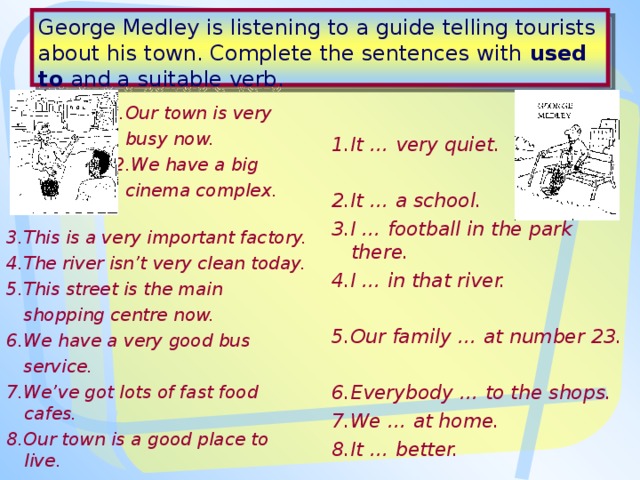
George Medley is listening to a guide telling tourists about his town. Complete the sentences with used to and a suitable verb.
1.Our town is very
busy now.
2.We have a big
cinema complex.
3.This is a very important factory.
4.The river isn’t very clean today.
5.This street is the main
shopping centre now.
6.We have a very good bus
service.
7.We’ve got lots of fast food cafes.
8.Our town is a good place to live .
1.It … very quiet.
2.It … a school.
3.I … football in the park there.
4.I … in that river.
5.Our family … at number 23.
6.Everybody … to the shops.
7.We … at home.
8.It … better.

George Medley is listening to a guide telling tourists about his town. Complete the sentences with used to and a suitable verb.
1.Our town is very
busy now.
2.We have a big
cinema complex.
3.This is a very important factory.
4.The river isn’t very clean today.
5.This street is the main
shopping centre now.
6.We have a very good bus
service.
7.We’ve got lots of fast food cafes.
8.Our town is a good place to live .
1.It … very quiet.
2.It … a school.
3.I … football in the park there.
4.I … in that river.
5.Our family … at number 23.
6.Everybody … to the shops.
7.We … at home.
8.It … better.

Вебинар для учителей
Свидетельство об участии БЕСПЛАТНО!