россия,

СДЕЛАЙТЕ СВОИ УРОКИ ЕЩЁ ЭФФЕКТИВНЕЕ, А ЖИЗНЬ СВОБОДНЕЕ
Благодаря готовым учебным материалам для работы в классе и дистанционно
Скидки до 50 % на комплекты
только до
Готовые ключевые этапы урока всегда будут у вас под рукой
Организационный момент
Проверка знаний
Объяснение материала
Закрепление изученного
Итоги урока
Была в сети 29.04.2026 09:18

Титова Светлана Вадимовна
учитель английского языка
42 года
 124
124
 205 931
Местоположение
Специализация
Russian education
Категория:
Английский язык
22.11.2020 18:41

Просмотр содержимого документа
«Russian education»
Russian education
Made by Svetlana Titova
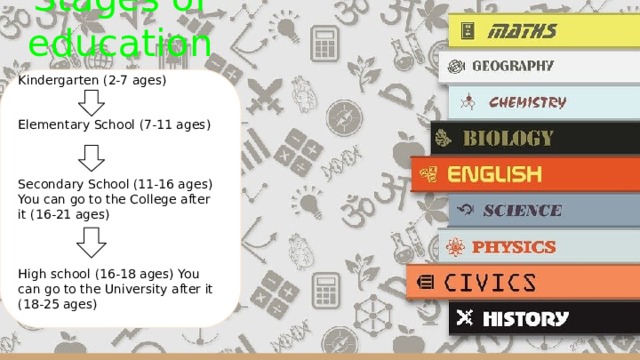
Stages of education
Kindergarten (2-7 ages)
Elementary School (7-11 ages)
Secondary School (11-16 ages) You can go to the Сollege after it (16-21 ages)
High school (16-18 ages) You can go to the University after it (18-25 ages)
Kindergarten
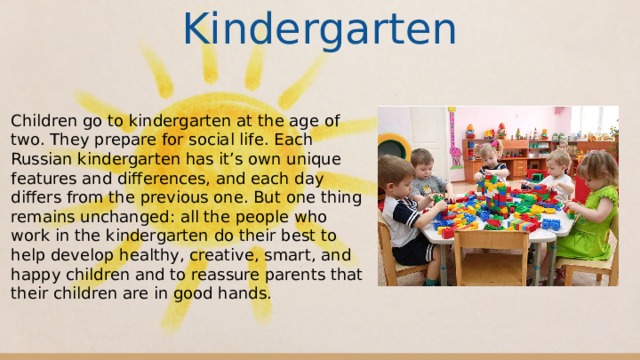
Children go to kindergarten at the age of two. They prepare for social life. Each Russian kindergarten has it’s own unique features and differences, and each day differs from the previous one. But one thing remains unchanged: all the people who work in the kindergarten do their best to help develop healthy, creative, smart, and happy children and to reassure parents that their children are in good hands.
Elementary School
Children go to school at the age of six or seven. They spend four years at Elementary School. School normally starts at 9 AM and finishes at 1 PM. Pupils have 3-4 lessons a day. Children have time to take a break b etween lessons. There is a wide range of school subjects for example Literature, PE, Russian, Math, Science, Technology, Art, Foreign Languages etc. Children can stay after lessons. They can do their homework and play with friends.
Sec ond ary School and Col led ge
Children spend 5 years in Secondary school,starting from the 5th and up to the 9th grade inclusive.Here they learn new sciences for themselves such as biology, chemistry and physics. Lessons start at 9 AM and finish at 3 PM. Pupils have 6-7 lessons a day and a lot of homework. Children have time between lessons to rest and eat in cafeteria. Students pass the OGE at the end of Secondary School. Сhildren have the choice to continue their studies in high school or go to Сollege after the end of the 9th grade. Сhildren spend an average of 5 years to get secondary vocational education in College.
High school and University
Children spend 2 years in High School. Students study hard for exams and university admission. The course involves further study of the main subjects and introduction to new rules and laws. Pupils have 6-7 lessons a day. Students also have additional classes on weekends. Students must pass the USE (USE - unified state examination) at the end of High School. Students choose a University to continue their studies after passing the exams.
Вебинар для учителей
Свидетельство об участии БЕСПЛАТНО!