

Узбекистан, Ташкент

СДЕЛАЙТЕ СВОИ УРОКИ ЕЩЁ ЭФФЕКТИВНЕЕ, А ЖИЗНЬ СВОБОДНЕЕ
Благодаря готовым учебным материалам для работы в классе и дистанционно
Скидки до 50 % на комплекты
только до
Готовые ключевые этапы урока всегда будут у вас под рукой
Организационный момент
Проверка знаний
Объяснение материала
Закрепление изученного
Итоги урока
Была в сети 19.01.2019 14:54

Бурханова Мадинабону Улугбек кизи
студентка 1-курса
 319
319
 139 557
Местоположение
English language presentation
Категория:
Английский язык
19.01.2019 14:54

Просмотр содержимого документа
«English language
presentation»

Tashkent state pedagogical university named after nizami
BELARUSIAN STATE PEDAGOGICAL UNIVERSITY NAMED AFTER MAXIM TANK
Faculty of Innovative Pedagogy
English language presentation prepared by student of 101 groups: Burkhanova M.

Theme:
What is a family?. The definite article. Rules of reading.

Plan
- What is family?
- a) History of theories and terminologies.
- b) Kinship terminology and roles.
- c) Types of family.
- d) Rights.
- The definite article “the”
- a) when to use
- b) when not to use
- c) exercise
- Reading
- a)Explanation
- b)Exercise

The definite article “the”
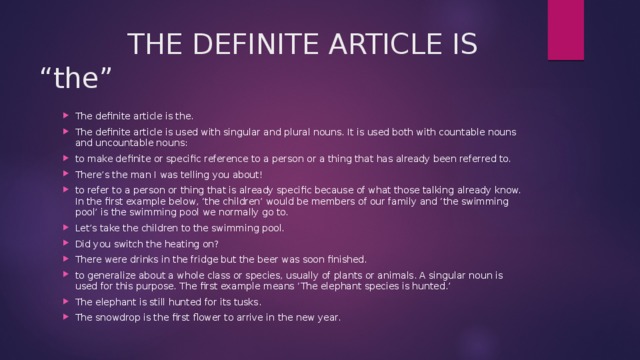
THE DEFINITE ARTICLE IS “the”
- The definite article is the.
- The definite article is used with singular and plural nouns. It is used both with countable nouns and uncountable nouns:
- to make definite or specific reference to a person or a thing that has already been referred to.
- There’s the man I was telling you about!
- to refer to a person or thing that is already specific because of what those talking already know. In the first example below, ‘the children’ would be members of our family and ‘the swimming pool’ is the swimming pool we normally go to.
- Let’s take the children to the swimming pool.
- Did you switch the heating on?
- There were drinks in the fridge but the beer was soon finished.
- to generalize about a whole class or species, usually of plants or animals. A singular noun is used for this purpose. The first example means ‘The elephant species is hunted.’
- The elephant is still hunted for its tusks.
- The snowdrop is the first flower to arrive in the new year.

- The article is part of speech in English, used mainly in front of nouns and characterizing them according to the degree of certainty - uncertainty.


- The definite article is rarely used with titles. Proper nouns that refer to persons, such as Sue and Ron, and proper nouns used in conjunction with titles, such as Queen Elizabeth, Doctor Thomas, and Captain Parry, only take a definite article if:
- they stand for the name of a thing such as a boat.
- The Queen Elizabeth II is on a long cruise.
- a distinction is being made between people who have identical names. This use can give emphasis to the noun.
- Ah, no. The David Parry I know lives in Manchester.
- I saw Paul Kay in town this morning. – Not the Paul Kay?

WHEN TO USE "THE "
- GENERAL RULES
- Use the to refer to something which has already been mentioned.
- Use the when you assume there is just one of something in that place, even if it has not been mentioned before.
- Use the in sentences or clauses where you define or identify a particular person or object.
- Use the to refer to people or objects that are unique.
- Use the before superlatives and ordinal numbers.
- Use the with adjectives, to refer to a whole group of people.
- Use the with decades.
- Use the with clauses introduced by only

- PROPER NOUNS
- Use the with names of geographical areas, rivers, mountain ranges, groups of islands, canals, and oceans.
- Use the with countries that have plural names
- Use the with countries that include the words "republic", "kingdom", or "states" in their names.
- Use the with newspaper names.
- Use the with the names of famous buildings, works of art, museums, or monuments.
- Use the with the names of hotels & restaurants, unless these are named after a person.
- Use the with the names of families, but not with the names of individuals.

WHEN NOT TO USE "THE"
- Do not use the with names of countries (except for the special cases above).
- Do not use the with the names of languages.
- Do not use the with the names of meals.
- Do not use the with people's names.
- Do not use the with titles when combined with names.
- Do not use the after the 's possessive case
- Do not use the with professions
- Do not use the with names of shops

- Do not use the with years
- Do not use the with uncountable nouns
- Do not use the with the names of individual mountains, lakes and islands
- Do not use the with most names of towns, streets, stations and airports

WHAT IS A FAMILY ?

Terminologies
- n his book Systems of Consanguinity and Affinity of the Human Family, anthropologist Lewis Henry Morgan (1818–1881) performed the first survey of kinship terminologies in use around the world. Although much of his work is now considered dated, he argued that kinship terminologies reflect different sets of distinctions. For example, most kinship terminologies distinguish between sexes (the difference between a brother and a sister) and between generations (the difference between a child and a parent). Moreover, he argued, kinship terminologies distinguish between relatives by blood and marriage (although recently some anthropologists have argued that many societies define kinship in terms other than "blood").
- Morgan made a distinction between kinship systems that use classificatory terminology and those that use descriptive terminology. Classificatory systems are generally and erroneously understood to be those that "class together" with a single term relatives who actually do not have the same type of relationship to ego. (What defines "same type of relationship" under such definitions seems to be genealogical relationship. This is problematic given that any genealogical description, no matter how standardized, employs words originating in a folk understanding of kinship.) What Morgan's terminology actually differentiates are those (classificatory) kinship systems that do not distinguish lineal and collateral relationships and those (descriptive) kinship systems that do. Morgan, a lawyer, came to make this distinction in an effort to understand Seneca inheritance practices. A Seneca man's effects were inherited by his sisters' children rather than by his own children.Morgan identified six basic patterns of kinship terminologies:

History of theories
- Early scholars of family history applied Darwin's biological theory of evolution in their theory of evolution of family systems. American anthropologist Lewis H. Morgan published Ancient Society in 1877 based on his theory of the three stages of human progress from Savagery through Barbarism to Civilization. Morgan's book was the "inspiration for Friedrich Engels' book" The Origin of the Family, Private Property and the State published in 1884.
- Engels expanded Morgan's hypothesis that economical factors caused the transformation of primitive community into a class-divided society.Engels' theory of resource control, and later that of Karl Marx, was used to explain the cause and effect of change in family structure and function. The popularity of this theory was largely unmatched until the 1980s, when other sociological theories, most notably structural functionalism, gained acceptance.
- The nuclear family in industrial society

- Family arrangements in the United States have become more diverse with no particular household arrangement representing half of the United States population.
- Contemporary society generally views the family as a haven from the world, supplying absolute fulfillment. Zinn and Eitzen discuss the image of the "family as haven a place of intimacy, love and trust where individuals may escape the competition of dehumanizing forces in modern society". During industrialization, "he family as a repository of warmth and tenderness (embodied by the mother) stands in opposition to the competitive and aggressive world of commerce (embodied by the father). The family's task was to protect against the outside world." However, Zinn and Eitzen note, "The protective image of the family has waned in recent years as the ideals of family fulfillment have taken shape. Today, the family is more compensatory than protective. It supplies what is vitally needed but missing in other social arrangements."
- "The popular wisdom", according to Zinn and Eitzen, sees the family structures of the past as superior to those today, and families as more stable and happier at a time when they did not have to contend with problems such as illegitimate children and divorce. They respond to this, saying, "there is no golden age of the family gleaming at us in the far back historical past." "Desertion by spouses, illegitimate children, and other conditions that are considered characteristics of modern times existed in the past as well."

Types of kinship
- Patrilineal
- Patrilineality, also known as the male line or agnatic kinship, is a form of kinship system in which an individual's family membership derives from and is traced through his or her father's lineage.It generally involves the inheritance of property, rights, names, or titles by persons related through male kin.
- A patriline ("father line") is a person's father, and additional ancestors that are traced only through males. One's patriline is thus a record of descent from a man in which the individuals in all intervening generations are male. In cultural anthropology, a patrilineage is a consanguineal male and female kinship group, each of whose members is descended from the common ancestor through male forebears.

- Matrilineal
- Matrilineality is a form of kinship system in which an individual's family membership derives from and is traced through his or her mother's lineage.
- It may also correlate with a societal system in which each person is identified with their matriline their mother's lineage and which can involve the inheritance of property and titles. A matriline is a line of descent from a female ancestor to a descendant in which the individuals in all intervening generations are mothers – in other words, a "mother line".
- In a matrilineal descent system, an individual is considered to belong to the same descent group as her or his mother. This matrilineal descent pattern is in contrasts to the more common pattern of patrilineal descent pattern.

- Bilateral descent
- Bilateral descent is a form of kinship system in which an individual's family membership derives from and is traced through both the paternal and maternal sides. The relatives on the mother's side and father's side are equally important for emotional ties or for transfer of property or wealth. It is a family arrangement where descent and inheritance are passed equally through both parents. Families who use this system trace descent through both parents simultaneously and recognize multiple ancestors, but unlike with cognatic descent it is not used to form descent groups.
- Traditionally, this is found among some groups in West Africa, India, Australia, Indonesia, Melanesia, Malaysia and Polynesia. Anthropologists believe that a tribal structure based on bilateral descent helps members live in extreme environments because it allows individuals to rely on two sets of families dispersed over a wide area.

Types of family
- Although early western cultural anthropologists and sociologists considered family and kinship to be universally associated with relations by "blood" (based on ideas common in their own cultures) later research[3] has shown that many societies instead understand family through ideas of living together, the sharing of food (e.g. milk kinship) and sharing care and nurture. Sociologists have a special interest in the function and status of family forms in stratified (especially capitalist) societies.
- According to the work of scholars Max Weber, Alan Macfarlane, Steven Ozment, Jack Goody and Peter Laslett, the huge transformation that led to modern marriage in Western democracies was "fueled by the religio-cultural value system provided by elements of Judaism, early Christianity, Roman Catholic canon law and the Protestant Reformation".
- Much sociological, historical and anthropological research dedicates itself to the understanding of this variation, and of changes in the family that form over time. Levitan claims:

- "Times have changed; it is more acceptable and encouraged for mothers to work and fathers to spend more time at home with the children. The way roles are balanced between the parents will help children grow and learn valuable life lessons. There is [the] great importance of communication and equality in families, in order to avoid role strain."

- Nuclear Family
- The nuclear family is the traditional type of family structure. This family type consists of two parents and children. The nuclear family was long held in esteem by society as being the ideal in which to raise children. Children in nuclear families receive strength and stability from the two-parent structure and generally have more opportunities due to the financial ease of two adults. According to U.S. Census data, almost 70 percent of children live in a nuclear family unit.
- Single Parent Family
- The single parent family consists of one parent raising one or more children on his own. Often, a single parent family is a mother with her children, although there are single fathers as well. The single parent family is the biggest change society has seen in terms of the changes in family structures. One in four children is born to a single mother. Single parent families are generally close and find ways to work together to solve problems, such as dividing up household chores. When only one parent is at home, it may be a struggle to find childcare, as there is only one parent working. This limits income and opportunities in many cases, although many single parent families have support from relatives and friends.
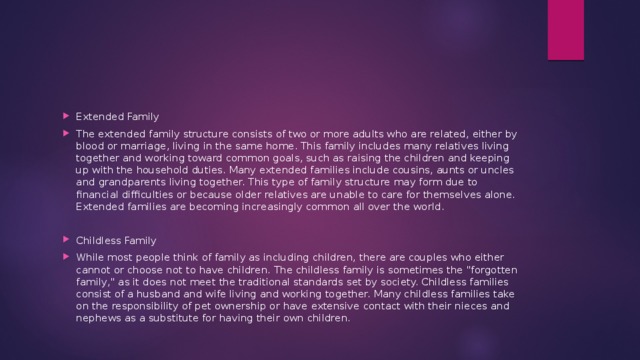
- Extended Family
- The extended family structure consists of two or more adults who are related, either by blood or marriage, living in the same home. This family includes many relatives living together and working toward common goals, such as raising the children and keeping up with the household duties. Many extended families include cousins, aunts or uncles and grandparents living together. This type of family structure may form due to financial difficulties or because older relatives are unable to care for themselves alone. Extended families are becoming increasingly common all over the world.
- Childless Family
- While most people think of family as including children, there are couples who either cannot or choose not to have children. The childless family is sometimes the "forgotten family," as it does not meet the traditional standards set by society. Childless families consist of a husband and wife living and working together. Many childless families take on the responsibility of pet ownership or have extensive contact with their nieces and nephews as a substitute for having their own children.

- Step Family
- Over half of all marriages end in divorce, and many of these individuals choose to get remarried. This creates the step or blended family which involves two separate families merging into one new unit. It consists of a new husband and wife and their children from previous marriages or relationships. Step families are about as common as the nuclear family, although they tend to have more problems, such as adjustment periods and discipline issues. Step families need to learn to work together and also work with their exes to ensure these family units run smoothly.
- Grandparent Family
- Many grandparents today are raising their grandchildren for a variety of reasons. One in fourteen children is raised by his grandparents, and the parents are not present in the child's life. This could be due to parents' death, addiction, abandonment or being unfit parents. Many grandparents need to go back to work or find additional sources of income to help raise their grandchildren.

- Variety of Structures
- There is no right or wrong answer when it comes to what is the best type of family structure. As long as a family is filled with love and support for one another, it tends to be successful and thrive. Families need to do what is best for each other and themselves, and that can be achieved in almost any unit.

Rights.
- Parents' rights
- The parents' rights movement is a movement whose members are primarily interested in issues affecting parents and children related to family law, specifically parental rights and obligations. Mothers' rights movements focus on maternal health, workplace issues such as labor rights, breastfeeding, and rights in family law. The fathers' rights movement is a movement whose members are primarily interested in issues related to family law, including child custody and child support, that affect fathers and their children.
- Children's rights
- Children's rights are the human rights of children, with particular attention to the rights of special protection and care afforded to minors, including their right to association with both parents, their right to human identity, their right to be provided in regard to their other basic needs, and their right to be free from violence and abuse

Poems

- This is the father
- short and stout
- This is the mother
- with children all about
- This is the brother, tall as you can see
- This is the sister,
- with a dolly on her knee
- This is the baby still to grow
- This is the family all in a row.

The end
Вебинар для учителей

Свидетельство об участии БЕСПЛАТНО!



