
Россия, Калининград


СДЕЛАЙТЕ СВОИ УРОКИ ЕЩЁ ЭФФЕКТИВНЕЕ, А ЖИЗНЬ СВОБОДНЕЕ
Благодаря готовым учебным материалам для работы в классе и дистанционно
Скидки до 50 % на комплекты
только до
Готовые ключевые этапы урока всегда будут у вас под рукой
Организационный момент
Проверка знаний
Объяснение материала
Закрепление изученного
Итоги урока

Была в сети 03.11.2023 22:16

Уланова Диана Аркадьевна
учитель английского языка
24 года
 58
58
 246 267
Местоположение
Фонетика английского языка
Категория:
Английский язык
03.11.2023 22:17

Просмотр содержимого документа
«Фонетика английского языка»
![Characteristics of [ae] According to: Monophthongs Fully front Open broad Unrounded Short sound Lax](https://static.multiurok.ru/multiurok/html/2023/11/03/s_6545472ba53d2/img0.jpg)
Characteristics of [ae] According to:
- Monophthongs
- Fully front
- Open broad
- Unrounded
- Short sound
- Lax
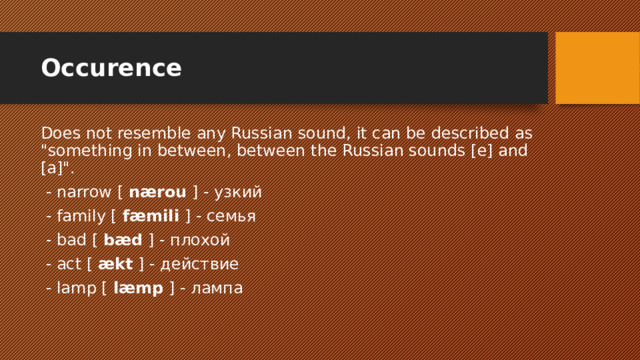
Occurence
Does not resemble any Russian sound, it can be described as "something in between, between the Russian sounds [e] and [a]".
- narrow [ nærou ] - узкий
- family [ fæmili ] - семья
- bad [ bæd ] - плохой
- act [ ækt ] - действие
- lamp [ læmp ] - лампа
![Articulation This is a short open sound. When pronouncing [æ], you need to pull the corners of the mouth to the sides a little, place the tongue as flat as possible in the mouth and lower the jaw quite vigorously. The English, of course, do not open their mouths wide when uttering the sound [æ]; they know how to place their tongue flat in their mouth. But vigorous work of the jaw is necessary to train this sound. Ideally, a very wide version of the Russian sound [e] with an admixture of the sound [a] should be heard.](https://static.multiurok.ru/multiurok/html/2023/11/03/s_6545472ba53d2/img2.jpg)
Articulation
This is a short open sound. When pronouncing [æ], you need to pull the corners of the mouth to the sides a little, place the tongue as flat as possible in the mouth and lower the jaw quite vigorously. The English, of course, do not open their mouths wide when uttering the sound [æ]; they know how to place their tongue flat in their mouth. But vigorous work of the jaw is necessary to train this sound. Ideally, a very wide version of the Russian sound [e] with an admixture of the sound [a] should be heard.
![Comparison with Russian In Russian, there is no sound similar to the sound [æ]. But sometimes, we often replace them with one - Russian / a /, which creates our rather recognizable accent (/ æ / can also be replaced by Russian / e /).](https://static.multiurok.ru/multiurok/html/2023/11/03/s_6545472ba53d2/img3.jpg)
Comparison with Russian
In Russian, there is no sound similar to the sound [æ].
But sometimes, we often replace them with one - Russian / a /, which creates our rather recognizable accent (/ æ / can also be replaced by Russian / e /).
![Tongue twisters 1) The fat black cat ran after the black rat, But the fat black rat ran away from the fat black cat. [ ðə fæt blæk kæt ræn ˈɑːftə ðə blæk ræt , bʌt ðə fæt blæk ræt ræn əˈweɪ frɒm ðə fæt blæk kæt .] 2) Mat has accidents, travelling by tram, Sam has accidents, travelling by taxi. If Mat didn’t have accidents, travelling by tram, Would Sam have accidents, travelling by taxi? [mæt hæz ˈæksɪdənts , ˈtrævlɪŋ baɪ træm , sæm hæz ˈæksɪdənts , ˈtrævlɪŋ baɪ ˈtæksi . ɪf mæt dɪdnt hæv ˈæksɪdənts , ˈtrævlɪŋ baɪ træm , wʊd sæm hæv ˈæksɪdənts , ˈtrævlɪŋ baɪ ˈtæksi ?]](https://static.multiurok.ru/multiurok/html/2023/11/03/s_6545472ba53d2/img4.jpg)
Tongue twisters
1) The fat black cat ran after the black rat,
But the fat black rat ran away from the fat black cat.
[ ðə fæt blæk kæt ræn ˈɑːftə ðə blæk ræt , bʌt ðə fæt blæk ræt ræn əˈweɪ frɒm ðə fæt blæk kæt .]
2) Mat has accidents, travelling by tram,
Sam has accidents, travelling by taxi.
If Mat didn’t have accidents, travelling by tram,
Would Sam have accidents, travelling by taxi?
[mæt hæz ˈæksɪdənts , ˈtrævlɪŋ baɪ træm , sæm hæz ˈæksɪdənts , ˈtrævlɪŋ baɪ ˈtæksi . ɪf mæt dɪdnt hæv ˈæksɪdənts , ˈtrævlɪŋ baɪ træm , wʊd sæm hæv ˈæksɪdənts , ˈtrævlɪŋ baɪ ˈtæksi ?]
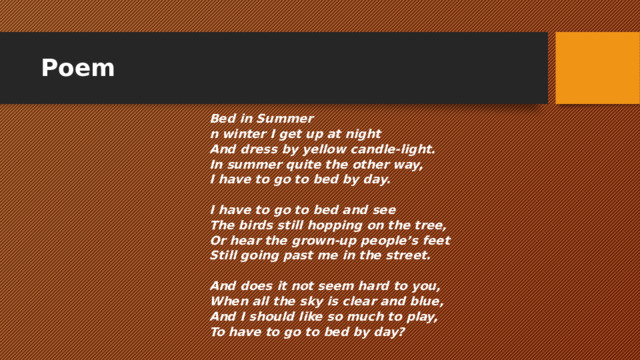
Poem
Bed in Summer
n winter I get up at night
And dress by yellow candle-light.
In summer quite the other way,
I have to go to bed by day.
I have to go to bed and see
The birds still hopping on the tree,
Or hear the grown-up people’s feet
Still going past me in the street.
And does it not seem hard to you,
When all the sky is clear and blue,
And I should like so much to play,
To have to go to bed by day?
![Idiomatic expressions It's like banging your head against a brick wall (Это все равно, что прошибать лбом стену) [ɪts laɪk ˈbæŋɪŋ jɔː hɛd əˈgɛnst ə brɪk wɔːl ] He's got his head in the clouds (Он витает в облаках) [hiːz gɒt hɪz hɛd ɪn ðə klaʊdz] An old head on young shoulders (Мудр не по годам) [ən əʊld hɛd ɒn jʌŋ ˈʃəʊldəz]](https://static.multiurok.ru/multiurok/html/2023/11/03/s_6545472ba53d2/img6.jpg)
Idiomatic expressions
It's like banging your head against a brick wall (Это все равно, что прошибать лбом стену)
[ɪts laɪk ˈbæŋɪŋ jɔː hɛd əˈgɛnst ə brɪk wɔːl ]
He's got his head in the clouds (Он витает в облаках)
[hiːz gɒt hɪz hɛd ɪn ðə klaʊdz]
An old head on young shoulders (Мудр не по годам)
[ən əʊld hɛd ɒn jʌŋ ˈʃəʊldəz]
![Academic text The universe is enormous, so the chances of us being the only living creatures are small. Although we think we are intelligent and that we know a lot about Space, we have only explored a very small area. We might be the only creatures that can travel in Space, but it is unlikely. In fact, some people say that we might have been visited by aliens. These people point to ‘wonders’ such as Stonehenge in Britain and the Nazca lines in Peru as proof that aliens have been here. So, what are the chances that there is life out there? [ðə ˈjuːnɪvɜːs ɪz ɪˈnɔːməs , səʊ ðə ˈʧɑːnsɪz ɒv ʌs ˈbiːɪŋ ði ˈəʊnli ˈlɪvɪŋ ˈkriːʧəz ɑː smɔːl . ɔːlˈðəʊ wiː θɪŋk wiː ɑːr ɪnˈtɛlɪʤənt ændðæt wiː nəʊ ə lɒt əˈbaʊt speɪs , wiː hæv ˈəʊnli ɪksˈplɔːd ə ˈvɛri smɔːl ˈeərɪə . wiː maɪt biː ði ˈəʊnli ˈkriːʧəz ðæt kæn ˈtrævl ɪnspeɪs , bʌt ɪt ɪz ʌnˈlaɪkli . ɪn fækt , sʌm ˈpiːpl seɪ ðæt wiː maɪt hæv biːn ˈvɪzɪtɪd baɪ ˈeɪliənz . ðiːz ˈpiːpl pɔɪnt tuː ˈwʌndəz sʌʧ æz ˈstəʊnhɛnʤ ɪn ˈbrɪtn ændðə Nazca laɪnz ɪn pəˈruː æz pruːf ðæt ˈeɪliənz hæv biːn hɪə . səʊ , wɒt ɑː ðə ˈʧɑːnsɪz ðæt ðeər ɪz laɪf aʊt ðeə ?]](https://static.multiurok.ru/multiurok/html/2023/11/03/s_6545472ba53d2/img7.jpg)
Academic text
The universe is enormous, so the chances of us being the only living creatures are small. Although we think we are intelligent and that we know a lot about Space, we have only explored a very small area. We might be the only creatures that can travel in Space, but it is unlikely.
In fact, some people say that we might have been visited by aliens. These people point to ‘wonders’ such as Stonehenge in Britain and the Nazca lines in Peru as proof that aliens have been here. So, what are the chances that there is life out there?
[ðə ˈjuːnɪvɜːs ɪz ɪˈnɔːməs , səʊ ðə ˈʧɑːnsɪz ɒv ʌs ˈbiːɪŋ ði ˈəʊnli ˈlɪvɪŋ ˈkriːʧəz ɑː smɔːl . ɔːlˈðəʊ wiː θɪŋk wiː ɑːr ɪnˈtɛlɪʤənt ændðæt wiː nəʊ ə lɒt əˈbaʊt speɪs , wiː hæv ˈəʊnli ɪksˈplɔːd ə ˈvɛri smɔːl ˈeərɪə . wiː maɪt biː ði ˈəʊnli ˈkriːʧəz ðæt kæn ˈtrævl ɪnspeɪs , bʌt ɪt ɪz ʌnˈlaɪkli . ɪn fækt , sʌm ˈpiːpl seɪ ðæt wiː maɪt hæv biːn ˈvɪzɪtɪd baɪ ˈeɪliənz . ðiːz ˈpiːpl pɔɪnt tuː ˈwʌndəz sʌʧ æz ˈstəʊnhɛnʤ ɪn ˈbrɪtn ændðə Nazca laɪnz ɪn pəˈruː æz pruːf ðæt ˈeɪliənz hæv biːn hɪə . səʊ , wɒt ɑː ðə ˈʧɑːnsɪz ðæt ðeər ɪz laɪf aʊt ðeə ?]








Вебинар для учителей

Свидетельство об участии БЕСПЛАТНО!