© 2020, Қабдолда Ғабит Қатиетолдаұлы 747 5

СДЕЛАЙТЕ СВОИ УРОКИ ЕЩЁ ЭФФЕКТИВНЕЕ, А ЖИЗНЬ СВОБОДНЕЕ
Благодаря готовым учебным материалам для работы в классе и дистанционно
Скидки до 50 % на комплекты
только до
Готовые ключевые этапы урока всегда будут у вас под рукой
Организационный момент
Проверка знаний
Объяснение материала
Закрепление изученного
Итоги урока
Был в сети 07.12.2020 18:32

Қабдолда Ғабит Қатиетолдаұлы
учитель английского языка
25 лет
 1 901
1 901
 37 005
Grade 7 unit 2 lesson plan
Категория:
Английский язык
07.12.2020 18:16

Просмотр содержимого документа
«Grade 7 unit 2 lesson plan»
| Unit2 Communication and technology | Secondary school named after B.Akhmetov | ||||
| Date:08.10.2020 | Teacher name: Kabdolda G.K. | ||||
| Grade:7 | Number present:9 | absent: | |||
| The theme | First conditional + may/might, be able to | ||||
| Learning objectives(s) that this lesson is contributing to | 7.UE12 use an increased variety of adverbs, including adverbs of degree too, not enough, quite , rather on a growing range of familiar general and curricular topics 7.L4 understand with limited support the main points of extended talk on a range of general and curricular topics 7.L5 understand most specific information and detail of supported, extended talk on a range general and curricular topics 7.W3 write with some support about personal feelings and opinions on a limited range of familiar general and curricular topics
| ||||
| Lesson objectives | All students will be able to use new topical vocabulary match at least 2 communication types to the speaker Most students will be able to match 2-3 communication types to the speaker Some students will be able to predict possible answers during listening activity give their opinion with the help of prompts | ||||
| Assessment criteria | Students will be considered successful if they are able to match the types of communication in listening section with 2-3 correct answers | ||||
| Value instilled at the lesson (including Global citizenship key elements (GC) | GC Knowledge and understanding: The importance of respect and protection of human rights. GC Skills: Understand personal strengths and weaknesses. GC Values and attitudes: appreciate own individuality and individuality of other people. | ||||
| Cross curricular links | Kazakh and Russian languages | ||||
| ICT skills | Interactive board | ||||
| Previous learning | Communication verbs | ||||
| Plan | |||||
| Planned timings | Planned activities (replace the notes below with your planned activities) | Children action | |||
| Beginning 10 min 2 min | Warming up: Lead in to the topic with a game of Chinese whispers (or Telephone). Organize Ss into large groups of at least six: they need to be able to whisper to each other without being overheard. Give one student in each group a sentence on a piece of paper (e.g. The large black dog bought a new mobile phone) The s whispers the sentence to the next student, but he/she shouldn’t repeat, and so on. The last player writes the sentence on the board.
T elicits from Ss the theme of the lesson and introduces the LO | Play game | |||
| Middle 5 min 20 min
13 min
10 min 10 min
| May or Might instead of Will in First Conditional May or might can also be used to substitute Will in First conditional sentences Compare will and may/might: If it’s sunny, I will go to the beach tomorrow. (I want to go to the beach tomorrow, so if the weather is good I’m certain that I will go) or If it’s sunny, I might go to the beach tomorrow. (I’m thinking of going to the beach tomorrow, if the weather is good it’s possible that I will go)
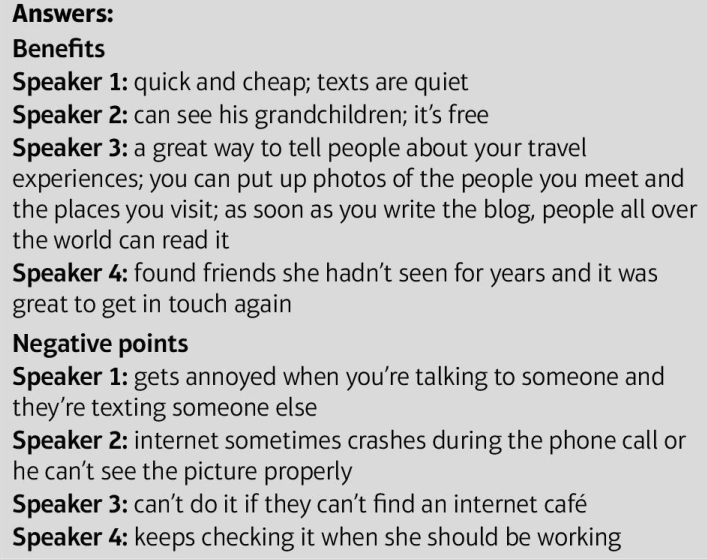
More examples: If I arrive early, I may/might go to the party. (it’s possible I will go to the party, but first I need to arrive early) If Mike doesn’t have a lot of work, he may/might go to rugby training. (it’s possible that Mike will go to training, but not if he has a lot of work) Johnny may play basketball tomorrow if the doctor says his leg is fine. (If the doctor gives his approval there’s a possibility that Johnny will play, but it’s not certain) Activity 1: Work in pairs. Look at the examples again. Use the words in the box to change or add more information. Definitely send May have Be able to Probably meet Might miss Listening: T plays the record twice and Ss match the speakers to the type of communication. T shows right answers on the PPT and Ss peer check. Answers: 1 text messages, 2 Skype, 3 a blog, 4 social networking sites Students listen again and note down the benefits and negative points the speakers mention.
Post-listening; Students discuss the advantages and disadvantages of technology.
Prompts: I get really annoyed when you’re talking to someone, but they’re texting to someone else. Generally, I think technology is …. The only problem with my smartphone is that I keep (gerund) when I should …
| Children do tasks | |||
| End 3 min | Feedback White-spots strategy Learners evaluate their achievement according LOs of the lesson. Learners write questions what was unclear and still needs some explanation. Homework: Student’s book p.n.21 ex.6 | | |||
Вебинар для учителей

Свидетельство об участии БЕСПЛАТНО!