Россия, Буйнакск

СДЕЛАЙТЕ СВОИ УРОКИ ЕЩЁ ЭФФЕКТИВНЕЕ, А ЖИЗНЬ СВОБОДНЕЕ
Благодаря готовым учебным материалам для работы в классе и дистанционно
Скидки до 50 % на комплекты
только до
Готовые ключевые этапы урока всегда будут у вас под рукой
Организационный момент
Проверка знаний
Объяснение материала
Закрепление изученного
Итоги урока
Была в сети 03.04.2026 13:34

Атаева Шагризат Мухудиновна
учитель информатики
56 лет
 38 758
 652
652 
Местоположение
Группа 2-5 Английский язык
Категория:
Английский язык
23.03.2020 12:54

Просмотр содержимого документа
«Группа 2-5 Английский язык»
Урок №
Предмет английский язык
Дата проведения23-24.03.2020 Преподаватель Аташева З.М.
Группа № 2-5
Тема урока: Научно технический прогресс»
Тип урока: комбинированный
Цели и задачи:
1.Совершенствование грамматических навыков
2.Формирование лексических навыков
3. Совершенствование навыков слуха.
4.Совершенствование навыков чтения.
Используемые на уроке средства ИКТ:
-персональный компьютер, мультимедийный проектор, экран книги, раздаточный материал;
Как правило, притяжательный падеж в английском языке используется с одушевленными существительными, которые обозначают людей и животных. Определяет этот падеж принадлежность, обладание чем-то, различные отношения. Если речь идет о синтаксической функции слова в притяжательном падеже, то ею будет функция определения. Например:
a girl’s future – будущее девочки (чье?)
students’ life – жизнь студентов (чья?)
a policeman’s uniform – форма полицейского (какая? чья?)
Mr. Davies’ office – офис мистера Дэвьеса
Если вы заметили, в приведенных примерах присутствует своеобразное окончание у имен существительных в притяжательном падеже на английском языке. Именно с помощью этого окончания – ‘s (апостроф s) – этот падеж и образуется. В письменном выражении мы имеем следующие варианты: ‘s – для существительных в единственном числе; ‘ (просто апостроф – apostrophe) – для существительных во множественном числе и для слов, заканчивающихся на -s, -ss, -x. Выглядит это следующим образом:
the secretaries’ working hours – рабочее время секретарей (множественное число)
lady’s handbag – женская сумочка (единственное число)
Здесь есть один момент: если имя собственное оканчивается на -s, апостроф можно использовать, а можно и пропустить:
St. James’ Park – Парк Святого Джеймса
В сложных именах существительных при образовании притяжательного падежа на английском языке мы добавляем окончание -s к последнему слову:
father-in-law’s flat – квартира тестя (свекра)
Стоит также обратить внимание на произношение окончания – s. После глухих это окончание читается как s, после звонких и гласных – как z, а после шипящих – iz.
С помощью притяжательного падежа в английском языке выражаются:
совместное владение чем-либо:
My son and daughter’s room
мера времени и расстояния:
a three-kilometer’s drive
a week’s vacation
какое-либо место (магазин, дом, мастерская и т.д.):
at the grocer’s
at the buther’s
at the dentist’s
значение «один из» в конструкции с предлогом of:
Christina is a friend of my sister’s
Если мы коснемся неодушевленных предметов, увидим, что их значение принадлежности принято выражать с помощью «of -фразы», то есть сочетания этого предлога с существительным. Например:
the cover of the book – обложка книги
the history of the English language – история английского языка
Тему притяжательного падежа в английском языке я отнесла бы к легким, но в то же время она весьма актуальна, так как мы говорим с помощью знаний в этой области постоянно.
II. Выполните упражнения по теме «Притяжательный падеж имен существительных»
1. Underline the correct words in bold
a. “Who is she?” “She’s Tom’s and Bob’s / Tom and Bob’s sister.
b. “Is this Paul / Paul’s?” “No, this is mine.”
c. “What’s your father’s / father name?
d. Where are the children’ / the children’s books?
e. This is the leg of / the leg’s the table.
f. Helen’s / Helens ball is green and white.
2. Write ’s in the correct place in the sentences as in the example
a. Tom is Liza’s cousin.
b. Is this Bob car?
c. Where’s Billy bag?
d. It’s Sara birthday on Monday.
e. What’s your wife name?
f. Peter is my brother friend.
g. Diana flat is in the centre of London.
h. My uncle name is Jack.
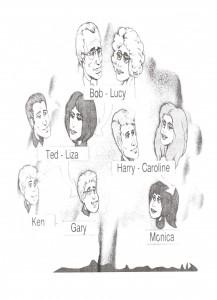
3. Underline the correct answer (Подчеркни правильный ответ).
a. Liza is Ted’s wife / grandmother.
b. Gary is Ken’s brother / cousin.
c. Bob is Monica’s grandfather / grandmother.
d. Ted is Ken and Gary’s father / uncle.
e. Caroline is Gary’s aunt / mother.
f. Harry is Caroline’s father / husband.
4. Look at the family tree and complete the sentences as in the example (Посмотри на семейное древо и заполни пропуски как в примере).
a. Harry is Caroline’s husband.
b. Monica is…………………………….daughter.
c. Lucy is…………………….mother.
d. Ken and Gary are…………….cousins.
e. Bob is ……………………..father.
f. Liza is……………..sister.
5. Correct the mistakes as in the example (Исправьте ошибки, как в примере).
a. Is that Tom’s and Peter umbrellas. Tom and Peter’s
b. The black hat is Toms’.
c. The roof’s house is grey.
d. When is your mothers birthday?
e. The bags are those women’.
f. Mice’s tails are grey.
g. Carols father lives in the countryside.
III. Прочитайте и переведите текст, ответьте на вопросы по тексту.
Computers.
Computer is an electronic device that can receive a set of instructions called program and then carry out them. The modern world of high technology could not be possible without computers. Different types and sizes of computers find uses throughout our society. They are used for the storage and handling of data, secret governmental files, information about banking transactions and so on.
Computers have opened up a new era in manufacturing and they have enhanced modern communication systems. They are essential tools in almost every field of research, from constructing models of the universe to producing tomorrow's weather reports. Using of different databases and computer networks make available a great variety of information sources.
There are two main types of computers, analog and digital, although the term computer is often used to mean only the digital type, because this type of computer is widely used today. That is why I am going to tell you about digital computers.
Everything that a digital computer does is based on one operation: the ability to determine: on or off, high voltage or low voltage or — in the case of numbers — 0 or 1 or do-called binary code. The speed at which the computer performs this simple act is called computer speed. Computer speeds are measured in Hertz or cycles per second. A computer with a «clock speed» of 2000 MHz is a fairly representative microcomputer today. It is capable of executing 2000 million discrete operations per second. Nowadays microcomputers can perform from 800 to over 3000 million operations per second and supercomputers used in research and defense applications attain speeds of many billions of cycles per second.
Digital computer speed and calculating power are further enhanced by the amount of data handled during each cycle. Except two main types of computers, analog and digital there are eight generations of digital computers or processing units. The first generation was represented by processing unit Intel 8086.
The second generation central processing unit was represented by processing unit Intel 80286, used in IBM PC AT 286. The third generation is Intel 80386, used in IBM PC AT 386. The microprocessors of the fourth generation were used in computers IBM PC AT 486. There are also central processing units of the fifth generation, used in Intel Pentium 60 and Intel Pentium 66, central processing units of the sixth generation, used in computers Intel Pentium 75, 90,100 and 133. Few years ago appeared central processing units of seventh and eighth generations. They are much more powerful and can perform from 2000 to over 3000 million operations per second.
Questions:
1. What is computer?
2. What is the main purpose of all computers?
3. Where are computers used?
4. What is the index of computer speed?
5. What speeds do modern computers have?
6. How many generations of digital computer are there?
7. What is the first generation processing unit?
Vocabulary:
electronic device — электронное устройство
to receive — получать, принимать
set of instructions — набор/свод инструкций
to carry out — выполнять
society — общество
storage — хранение
handling — обработка
transaction — операция
to enhance — повышать, увеличивать
essential — существенный
tool — инструмент, орудие
network — сеть
source — источник
analog — аналоговый
digital — цифровой
ability — способность, возможность
to determine — определять
voltage — напряжение
discrete operation — дискретное действие
to perform — выполнять, осуществлять
defense — оборона, защита
to attain — достигать
amount of data — объем данных
except — за исключением, кроме
processing unit — вычислительное устройство
Вебинар для учителей
Свидетельство об участии БЕСПЛАТНО!