россия, петрозаводск

СДЕЛАЙТЕ СВОИ УРОКИ ЕЩЁ ЭФФЕКТИВНЕЕ, А ЖИЗНЬ СВОБОДНЕЕ
Благодаря готовым учебным материалам для работы в классе и дистанционно
Скидки до 50 % на комплекты
только до
Готовые ключевые этапы урока всегда будут у вас под рукой
Организационный момент
Проверка знаний
Объяснение материала
Закрепление изученного
Итоги урока

Был в сети 03.07.2019 15:10

джанелидзе александр шалвович
преподаватель английского языка
82 года
 7 535
7 535
 7 327
7 327 
Местоположение
Специализация
Континент Австралия
Категория:
Английский язык
21.08.2018 11:28

Просмотр содержимого документа
«Континент Австралия»
Contents
History
The geographical position of Australia.
Nature
Population
Emblem and flag
History
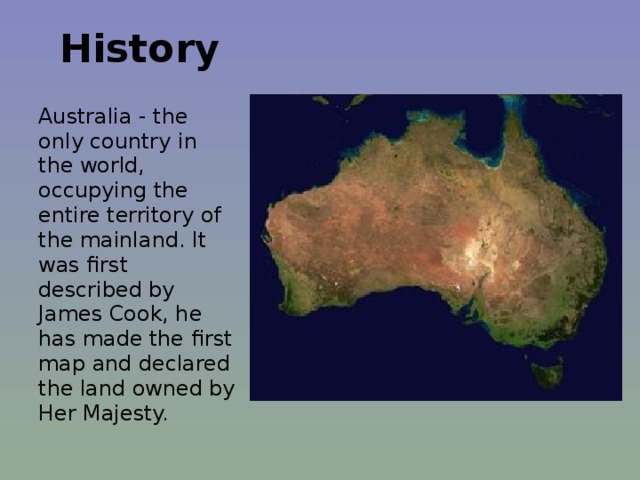
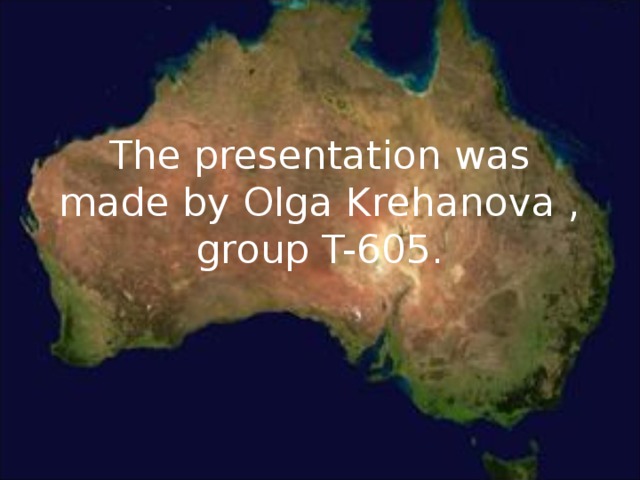
Australia - the only country in the world, occupying the entire territory of the mainland. It was first described by James Cook, he has made the first map and declared the land owned by Her Majesty.
The geographical position of Australia
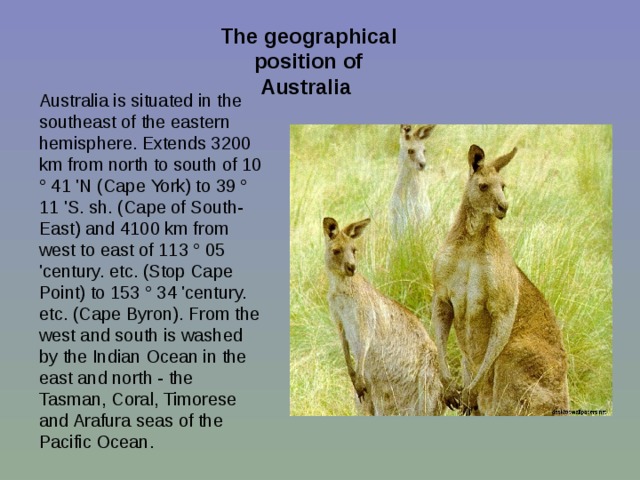
Australia is situated in the southeast of the eastern hemisphere. Extends 3200 km from north to south of 10 ° 41 'N (Cape York) to 39 ° 11 'S. sh. (Cape of South-East) and 4100 km from west to east of 113 ° 05 'century. etc. (Stop Cape Point) to 153 ° 34 'century. etc. (Cape Byron). From the west and south is washed by the Indian Ocean in the east and north - the Tasman, Coral, Timorese and Arafura seas of the Pacific Ocean.
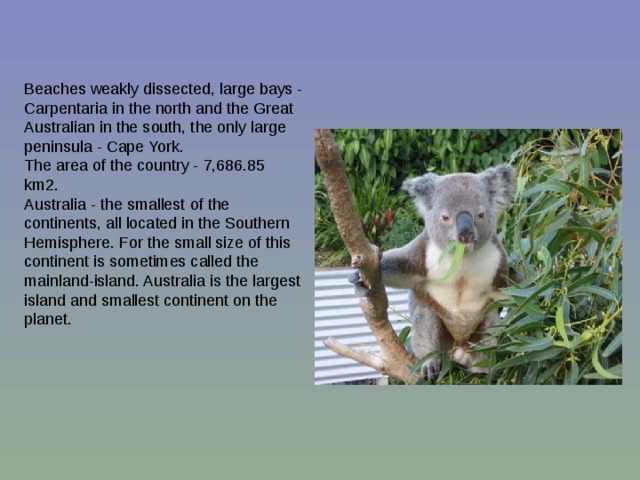
Beaches weakly dissected, large bays - Carpentaria in the north and the Great Australian in the south, the only large peninsula - Cape York. The area of the country - 7,686.85 km2. Australia - the smallest of the continents, all located in the Southern Hemisphere. For the small size of this continent is sometimes called the mainland-island. Australia is the largest island and smallest continent on the planet.
Nature
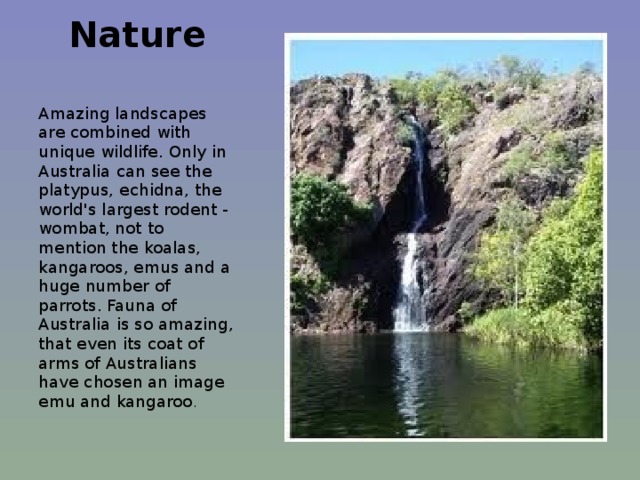
Amazing landscapes are combined with unique wildlife. Only in Australia can see the platypus, echidna, the world's largest rodent - wombat, not to mention the koalas, kangaroos, emus and a huge number of parrots. Fauna of Australia is so amazing, that even its coat of arms of Australians have chosen an image emu and kangaroo .
Population
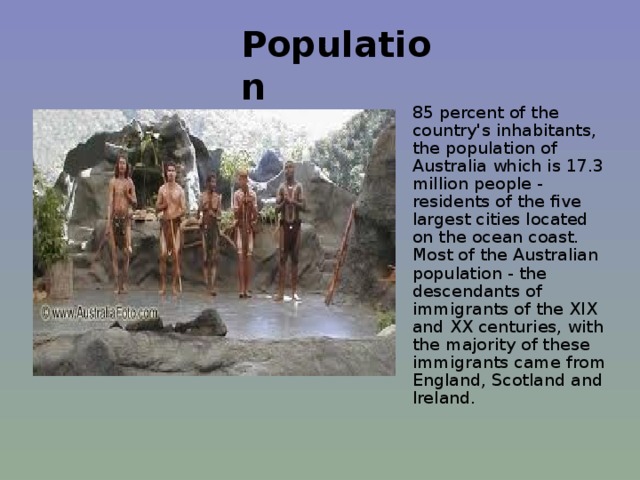
85 percent of the country's inhabitants, the population of Australia which is 17.3 million people - residents of the five largest cities located on the ocean coast. Most of the Australian population - the descendants of immigrants of the XIX and XX centuries, with the majority of these immigrants came from England, Scotland and Ireland.
Emblem and flag
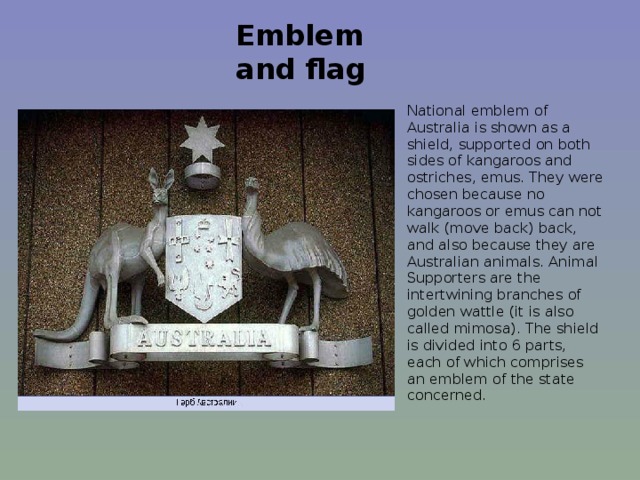
National emblem of Australia is shown as a shield, supported on both sides of kangaroos and ostriches, emus. They were chosen because no kangaroos or emus can not walk (move back) back, and also because they are Australian animals. Animal Supporters are the intertwining branches of golden wattle (it is also called mimosa). The shield is divided into 6 parts, each of which comprises an emblem of the state concerned.
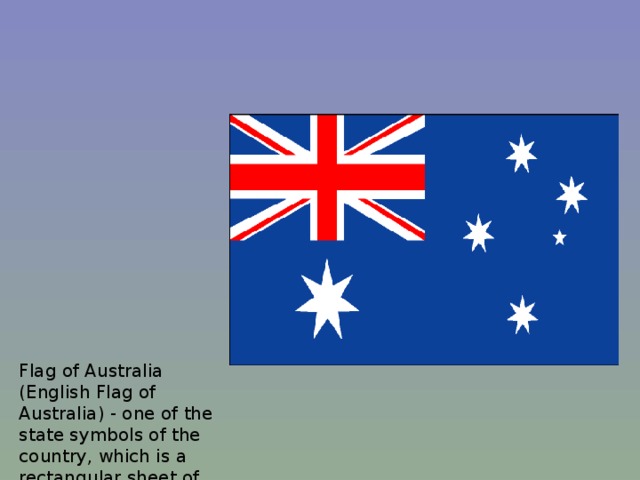
Flag of Australia (English Flag of Australia) - one of the state symbols of the country, which is a rectangular sheet of blue color with an aspect ratio of 1:2. In the upper left quarter shows a British flag. In addition, the flag of Australia is an image of six white stars: five stars as the Southern Cross constellation on the right side of the cloth, and one big star in the center of the left lower quadrant.
Test
1.Who was the first who described Australia? a)James Cook b)Michael Haynes c)Christopher Columbus
2.What is the populationThe number of Australia? a)14.5 million b)17.3 million c)15.8 million
3.Which animals are depicted on the emblem of Australia? a)Platypus and kangaroo b)Koala and ostrich c)Kangaroo and ostrich
4. How many parts is shield depicted on the emblem divided for? a)5 b)6 c)4
5. How many stars are depicted on the flag of Australia? a)4 b)5 c)6
The presentation was made by Olga Krehanova , group T-605.

Вебинар для учителей

Свидетельство об участии БЕСПЛАТНО!