Россия, Одинцово


СДЕЛАЙТЕ СВОИ УРОКИ ЕЩЁ ЭФФЕКТИВНЕЕ, А ЖИЗНЬ СВОБОДНЕЕ
Благодаря готовым учебным материалам для работы в классе и дистанционно
Скидки до 50 % на комплекты
только до
Готовые ключевые этапы урока всегда будут у вас под рукой
Организационный момент
Проверка знаний
Объяснение материала
Закрепление изученного
Итоги урока

Была в сети 27.12.2024 11:42

Гнедькова Оксана Витальевна
Учитель английского языка
47 лет
 857
857
 74 388
Местоположение
Специализация
Наука и технологии в США.
Категория:
Английский язык
29.05.2017 12:46

Просмотр содержимого документа
«Наука и технологии в США.»
Science and technology in the United States
Early North American Science
In the early decades of its history, the United States was relatively isolated from Europe and also rather poor. At this stage America's scientific infrastructure was still quite primitive compared to the long-established societies, institutes, and universities in Europe.
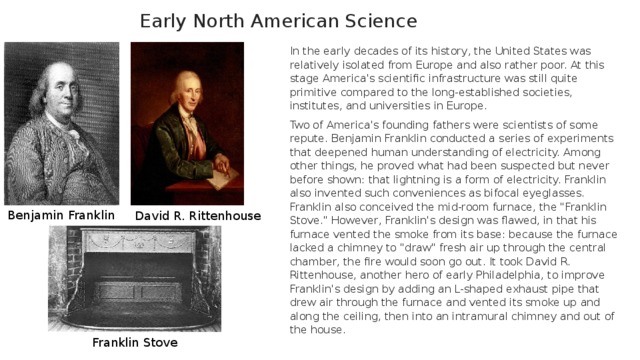
Two of America's founding fathers were scientists of some repute. Benjamin Franklin conducted a series of experiments that deepened human understanding of electricity. Among other things, he proved what had been suspected but never before shown: that lightning is a form of electricity. Franklin also invented such conveniences as bifocal eyeglasses. Franklin also conceived the mid-room furnace, the "Franklin Stove." However, Franklin's design was flawed, in that his furnace vented the smoke from its base: because the furnace lacked a chimney to "draw" fresh air up through the central chamber, the fire would soon go out. It took David R. Rittenhouse, another hero of early Philadelphia, to improve Franklin's design by adding an L-shaped exhaust pipe that drew air through the furnace and vented its smoke up and along the ceiling, then into an intramural chimney and out of the house.
Benjamin Franklin
David R. Rittenhouse
Franklin Stove
American Applied Science
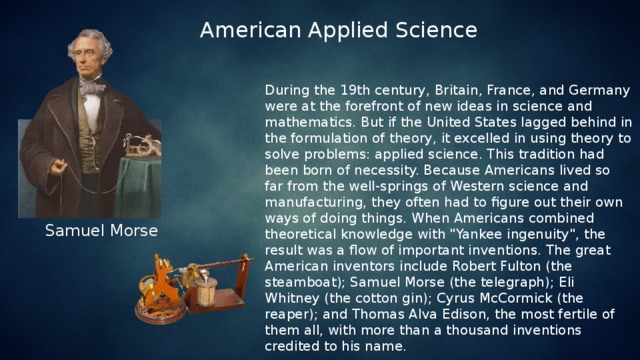
During the 19th century, Britain, France, and Germany were at the forefront of new ideas in science and mathematics. But if the United States lagged behind in the formulation of theory, it excelled in using theory to solve problems: applied science. This tradition had been born of necessity. Because Americans lived so far from the well-springs of Western science and manufacturing, they often had to figure out their own ways of doing things. When Americans combined theoretical knowledge with "Yankee ingenuity", the result was a flow of important inventions. The great American inventors include Robert Fulton (the steamboat); Samuel Morse (the telegraph); Eli Whitney (the cotton gin); Cyrus McCormick (the reaper); and Thomas Alva Edison, the most fertile of them all, with more than a thousand inventions credited to his name.
Samuel Morse
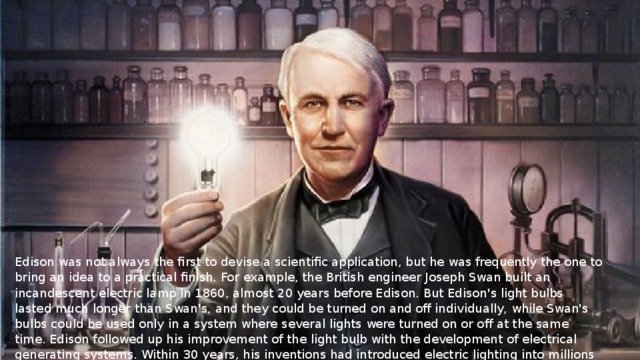
Edison was not always the first to devise a scientific application, but he was frequently the one to bring an idea to a practical finish. For example, the British engineer Joseph Swan built an incandescent electric lamp in 1860, almost 20 years before Edison. But Edison's light bulbs lasted much longer than Swan's, and they could be turned on and off individually, while Swan's bulbs could be used only in a system where several lights were turned on or off at the same time. Edison followed up his improvement of the light bulb with the development of electrical generating systems. Within 30 years, his inventions had introduced electric lighting into millions of homes.
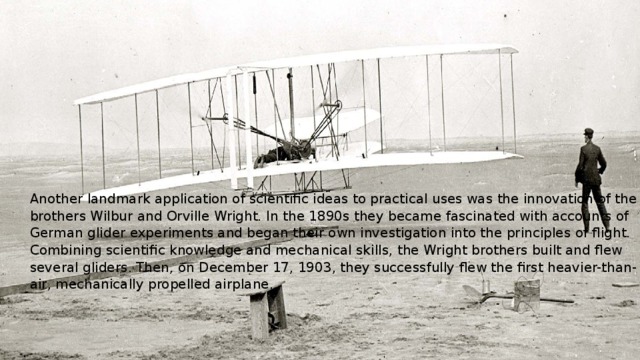
Another landmark application of scientific ideas to practical uses was the innovation of the brothers Wilbur and Orville Wright. In the 1890s they became fascinated with accounts of German glider experiments and began their own investigation into the principles of flight. Combining scientific knowledge and mechanical skills, the Wright brothers built and flew several gliders. Then, on December 17, 1903, they successfully flew the first heavier-than-air, mechanically propelled airplane.
.
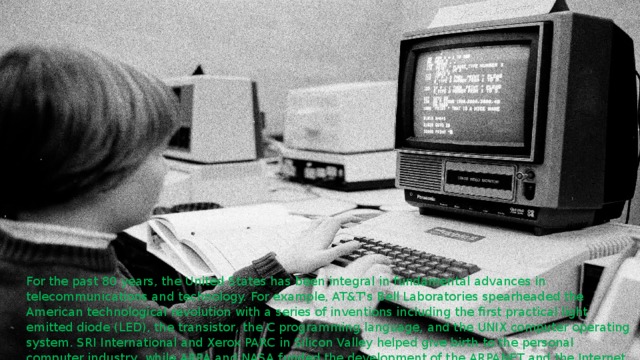
For the past 80 years, the United States has been integral in fundamental advances in telecommunications and technology. For example, AT&T's Bell Laboratories spearheaded the American technological revolution with a series of inventions including the first practical light emitted diode (LED), the transistor, the C programming language, and the UNIX computer operating system. SRI International and Xerox PARC in Silicon Valley helped give birth to the personal computer industry, while ARPA and NASA funded the development of the ARPANET and the Internet
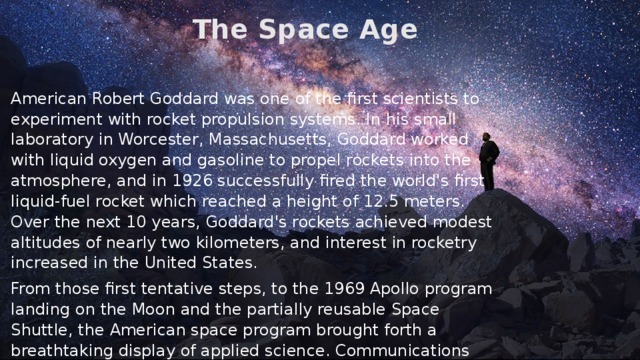
The Space Age
American Robert Goddard was one of the first scientists to experiment with rocket propulsion systems. In his small laboratory in Worcester, Massachusetts, Goddard worked with liquid oxygen and gasoline to propel rockets into the atmosphere, and in 1926 successfully fired the world's first liquid-fuel rocket which reached a height of 12.5 meters. Over the next 10 years, Goddard's rockets achieved modest altitudes of nearly two kilometers, and interest in rocketry increased in the United States.
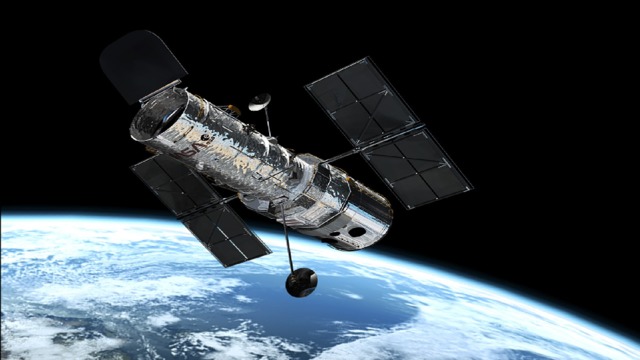
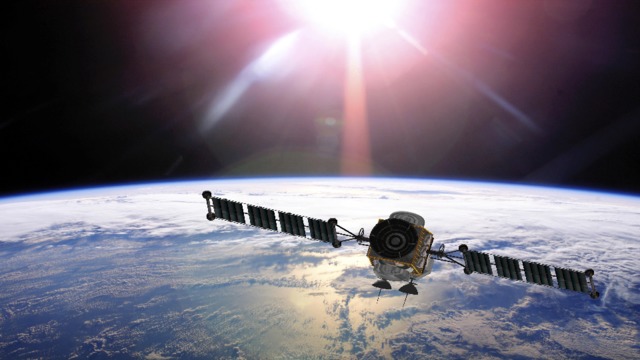
From those first tentative steps, to the 1969 Apollo program landing on the Moon and the partially reusable Space Shuttle, the American space program brought forth a breathtaking display of applied science. Communications satellites transmit computer data, telephone calls, and radio and television broadcasts. Weather satellites furnish the data necessary to provide early warnings of severe storms. Global positioning satellites were first developed in the US starting around 1972, and became fully operational by 1994. Interplanetary probes and space telescopes began a golden age of planetary science and advanced a wide variety of astronomical work.








Вебинар для учителей

Свидетельство об участии БЕСПЛАТНО!