Россия, Севастополь

СДЕЛАЙТЕ СВОИ УРОКИ ЕЩЁ ЭФФЕКТИВНЕЕ, А ЖИЗНЬ СВОБОДНЕЕ
Благодаря готовым учебным материалам для работы в классе и дистанционно
Скидки до 50 % на комплекты
только до
Готовые ключевые этапы урока всегда будут у вас под рукой
Организационный момент
Проверка знаний
Объяснение материала
Закрепление изученного
Итоги урока
Была в сети 10.07.2021 14:06

Назина Валерия Дмитриевна
учитель английского языка
31 год
 356
356
 129 935
Местоположение
Passive Voice = Пассивный залог
Категория:
Английский язык
25.05.2020 10:46

Просмотр содержимого документа
«Passive Voice = Пассивный залог»
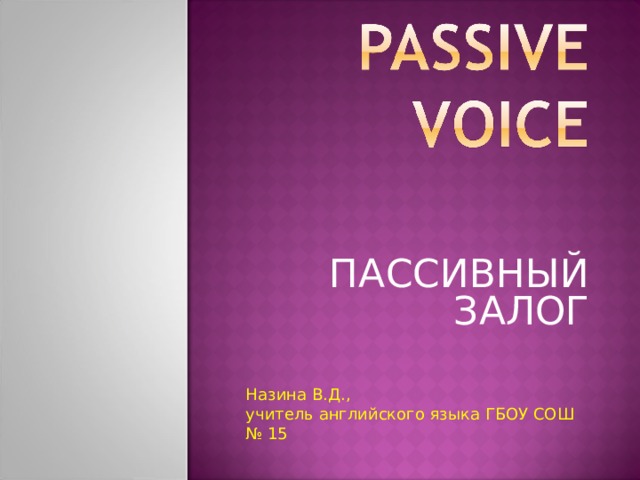
ПАССИВНЫЙ ЗАЛОГ
Назина В.Д.,
учитель английского языка ГБОУ СОШ № 15

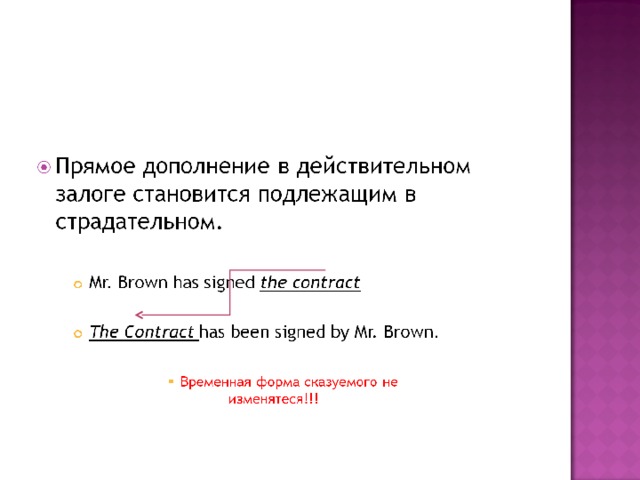
- Залог – это форма глагола, которая показывает, является ли подлежащее предложения производителем или объектом действия, выраженного сказуемым.
- В английском языке есть два залога:
- Active Voice – действительный залог;
- Passive Voice – страдательный залог.
- Страдательный залог употребляется, когда исполнитель действия очевиден или несущественен, или когда действие или его результат более интересны, чем исполнитель.
- Страдательный залог образуется с помощью глагола to be в соответствующем времени и III формы глагола (причастие II)
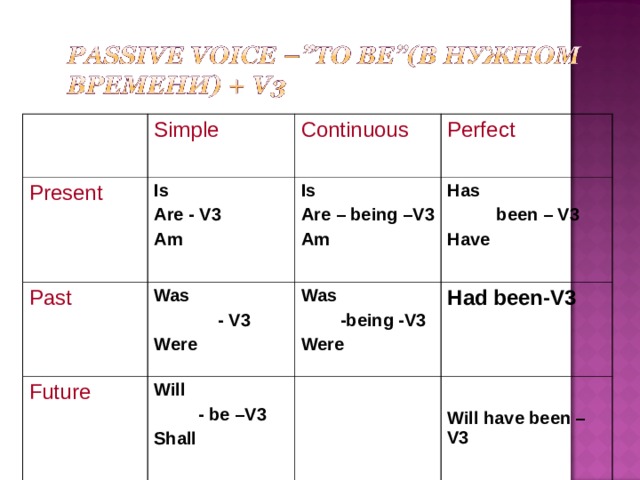
Simple
Present
Is
Are - V3
Am
Continuous
Past
Perfect
Is
Are – being –V3
Am
Was
- V3
Were
Future
Has
been – V3
Have
Will
- be –V3
Shall
Was
-being -V3
Were
Had been-V3
Will have been –V3
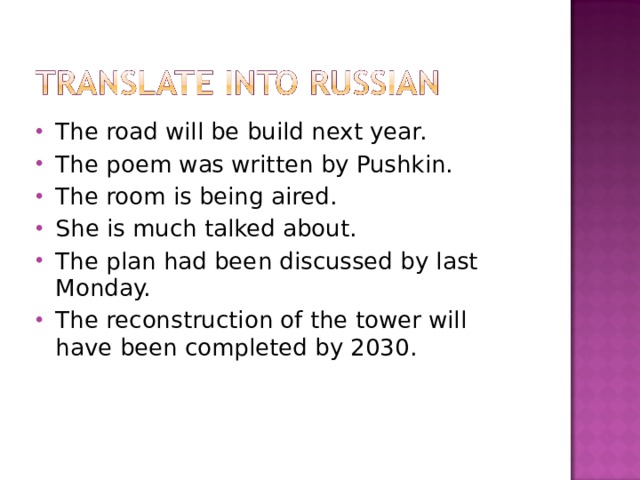
- The road will be build next year.
- The poem was written by Pushkin.
- The room is being aired.
- She is much talked about.
- The plan had been discussed by last Monday.
- The reconstruction of the tower will have been completed by 2030.
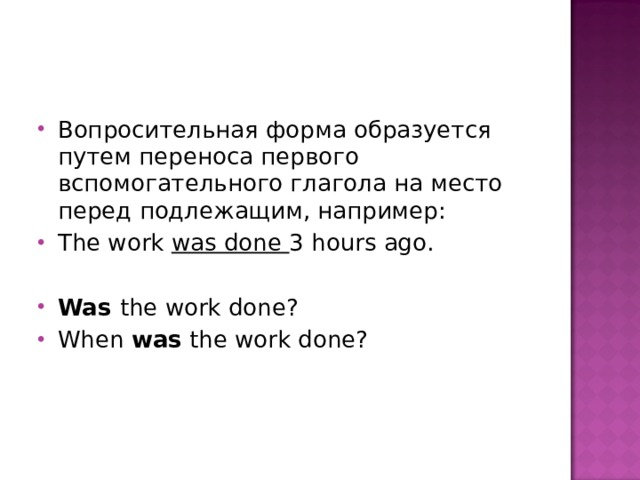
- Вопросительная форма образуется путем переноса первого вспомогательного глагола на место перед подлежащим, например:
- The work was done 3 hours ago.
- Was the work done?
- When was the work done?
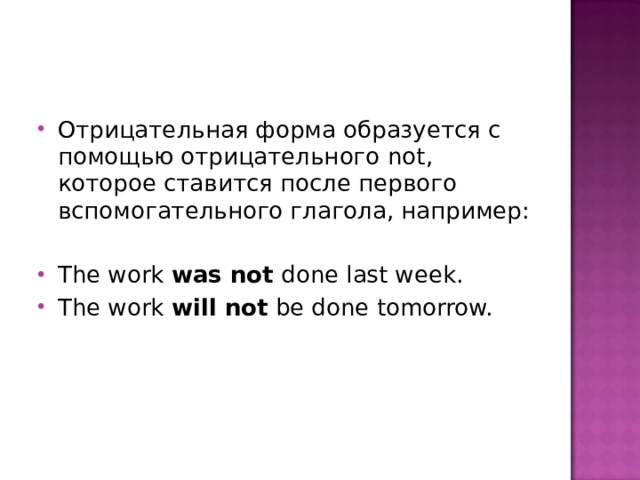
- Отрицательная форма образуется с помощью отрицательного not, которое ставится после первого вспомогательного глагола, например:
- The work was not done last week.
- The work will not be done tomorrow.
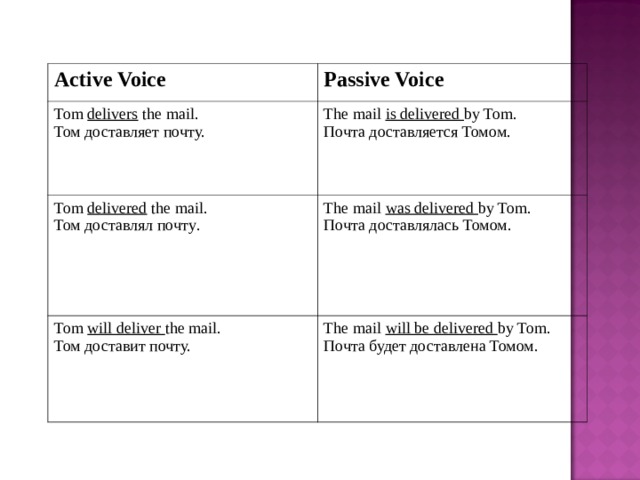
Active Voice
Passive Voice
Tom delivers the mail.
Том доставляет почту.
The mail is delivered by Tom.
Почта доставляется Томом.
Tom delivered the mail.
Том доставлял почту .
The mail was delivered by Tom.
Почта доставлялась Томом.
Tom will deliver the mail.
Том доставит почту.
The mail will be delivered by Tom.
Почта будет доставлена Томом.
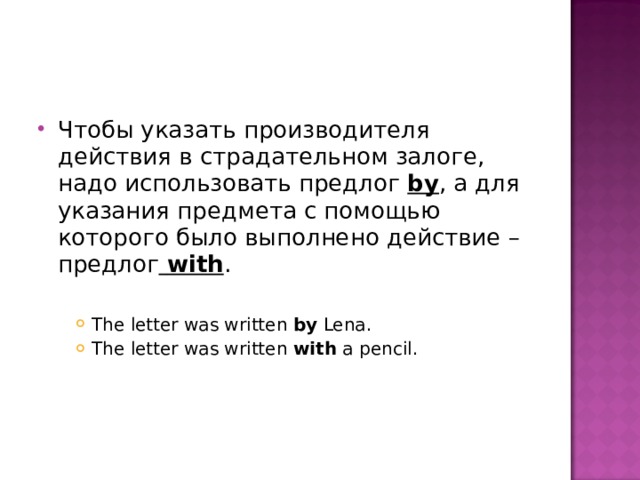
- Чтобы указать производителя действия в страдательном залоге, надо использовать предлог by , а для указания предмета с помощью которого было выполнено действие – предлог with .
- The letter was written by Lena. The letter was written with a pencil.
- The letter was written by Lena. The letter was written with a pencil.
- The letter was written by Lena.
- The letter was written with a pencil.
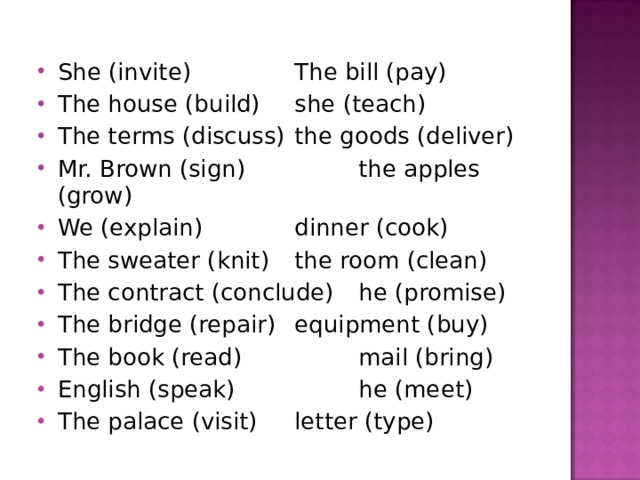
- She (invite) The bill (pay)
- The house (build) she (teach)
- The terms (discuss) the goods (deliver)
- Mr. Brown (sign) the apples (grow)
- We (explain) dinner (cook)
- The sweater (knit) the room (clean)
- The contract (conclude) he (promise)
- The bridge (repair) equipment (buy)
- The book (read) mail (bring)
- English (speak) he (meet)
- The palace (visit) letter (type)
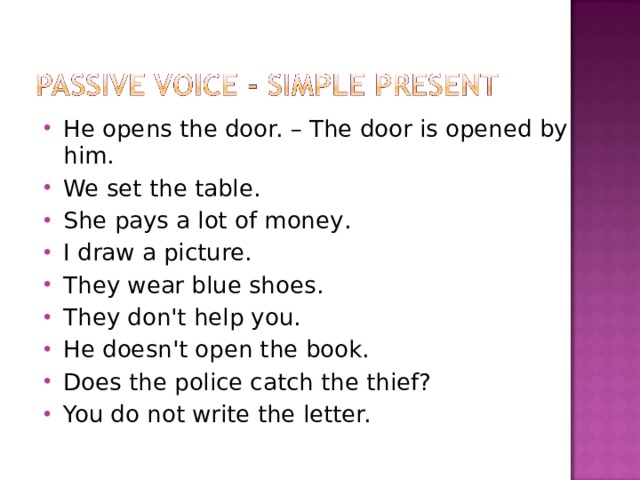
- He opens the door. – The door is opened by him.
- We set the table.
- She pays a lot of money .
- I draw a picture.
- They wear blue shoes.
- They don't help you.
- He doesn't open the book.
- Does the police catch the thief?
- You do not write the letter.
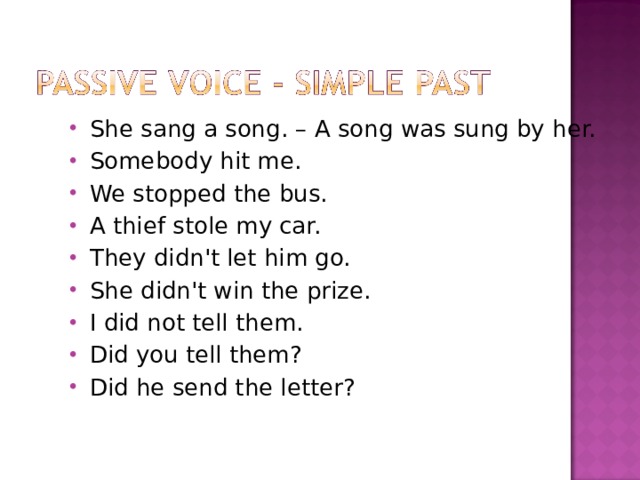
- She sang a song. – A song was sung by her.
- Somebody hit me.
- We stopped the bus.
- A thief stole my car.
- They didn't let him go.
- She didn't win the prize.
- I did not tell them.
- Did you tell them?
- Did he send the letter?
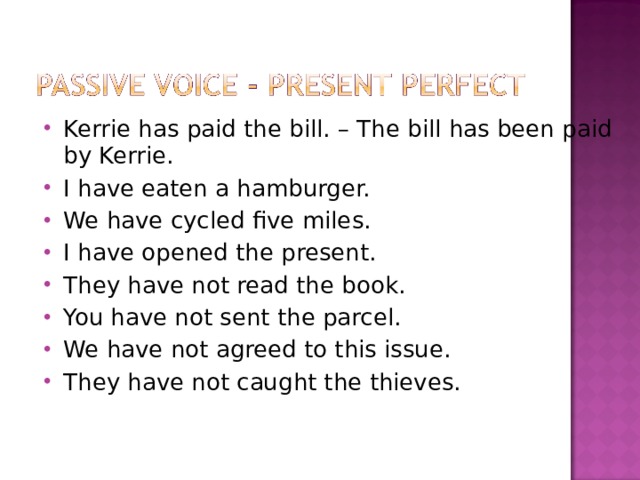
- Kerrie has paid the bill. – The bill has been paid by Kerrie.
- I have eaten a hamburger.
- We have cycled five miles.
- I have opened the present.
- They have not read the book.
- You have not sent the parcel.
- We have not agreed to this issue.
- They have not caught the thieves.
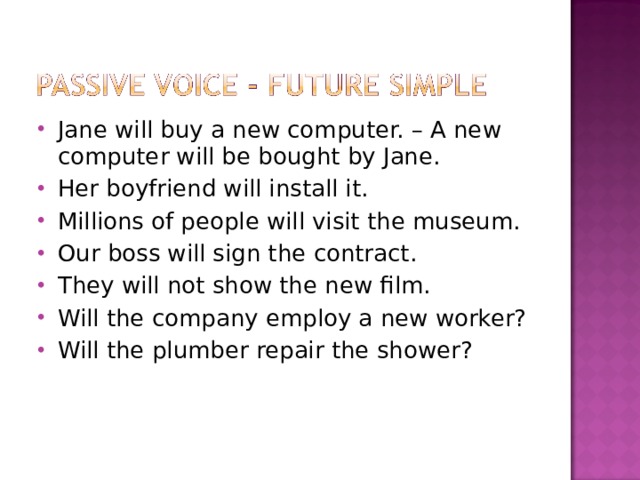
- Jane will buy a new computer. – A new computer will be bought by Jane.
- Her boyfriend will install it.
- Millions of people will visit the museum.
- Our boss will sign the contract.
- They will not show the new film.
- Will the company employ a new worker?
- Will the plumber repair the shower?
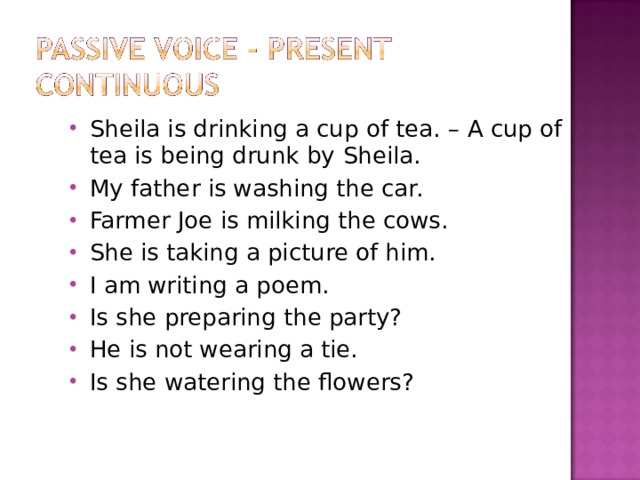
- Sheila is drinking a cup of tea. – A cup of tea is being drunk by Sheila.
- My father is washing the car.
- Farmer Joe is milking the cows.
- She is taking a picture of him.
- I am writing a poem.
- Is she preparing the party?
- He is not wearing a tie.
- Is she watering the flowers?
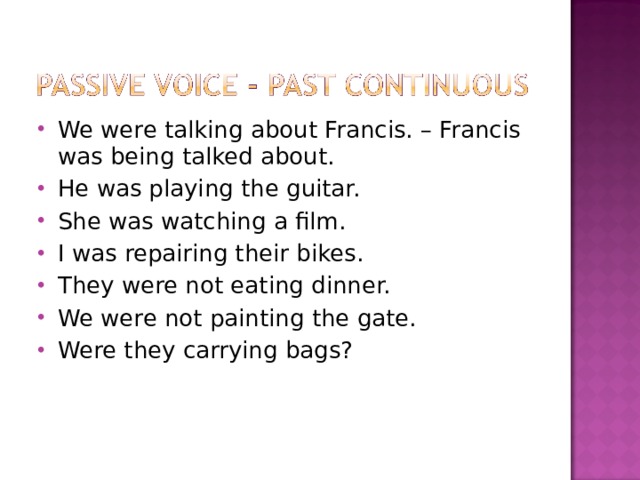
- We were talking about Francis. – Francis was being talked about.
- He was playing the guitar.
- She was watching a film.
- I was repairing their bikes.
- They were not eating dinner.
- We were not painting the gate.
- Were they carrying bags?
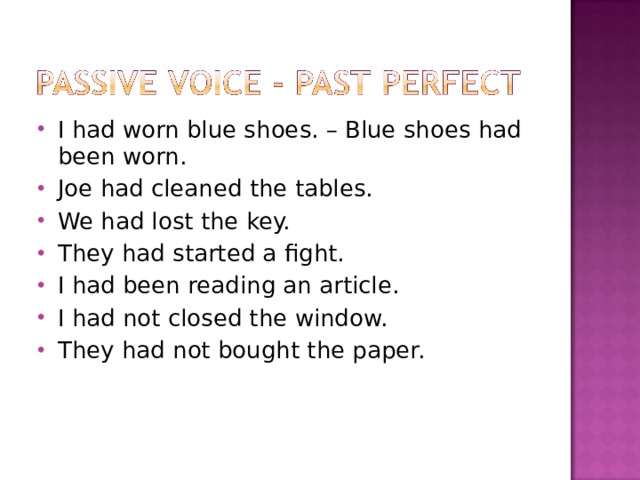
- I had worn blue shoes. – Blue shoes had been worn.
- Joe had cleaned the tables.
- We had lost the key.
- They had started a fight.
- I had been reading an article.
- I had not closed the window.
- They had not bought the paper.
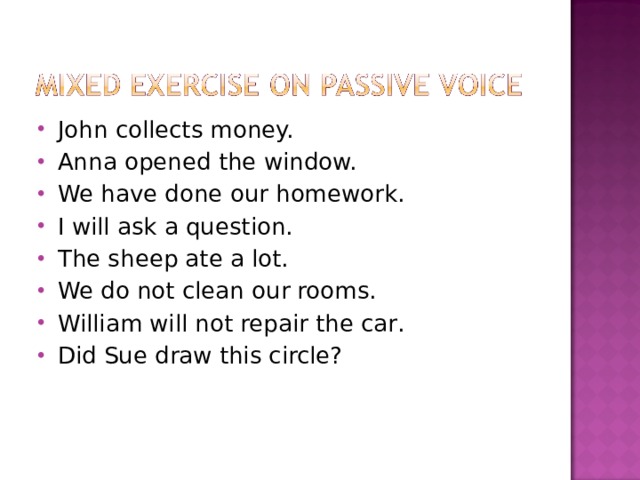
- John collects money.
- Anna opened the window.
- We have done our homework.
- I will ask a question.
- The sheep ate a lot.
- We do not clean our rooms.
- William will not repair the car .
- Did Sue draw this circle?








Вебинар для учителей

Свидетельство об участии БЕСПЛАТНО!