, КЕРЧЬ

СДЕЛАЙТЕ СВОИ УРОКИ ЕЩЁ ЭФФЕКТИВНЕЕ, А ЖИЗНЬ СВОБОДНЕЕ
Благодаря готовым учебным материалам для работы в классе и дистанционно
Скидки до 50 % на комплекты
только до
Готовые ключевые этапы урока всегда будут у вас под рукой
Организационный момент
Проверка знаний
Объяснение материала
Закрепление изученного
Итоги урока
Была в сети 31.05.2025 20:08

Толмачева Наталья Николаевна
учитель английского языка
 3 185
3 185
 21 460
Местоположение
Специализация
Презентации "С Днем Победы!"
Категория:
Английский язык
11.04.2015 21:24

Просмотр содержимого документа
«Презентации "С Днем Победы!"»
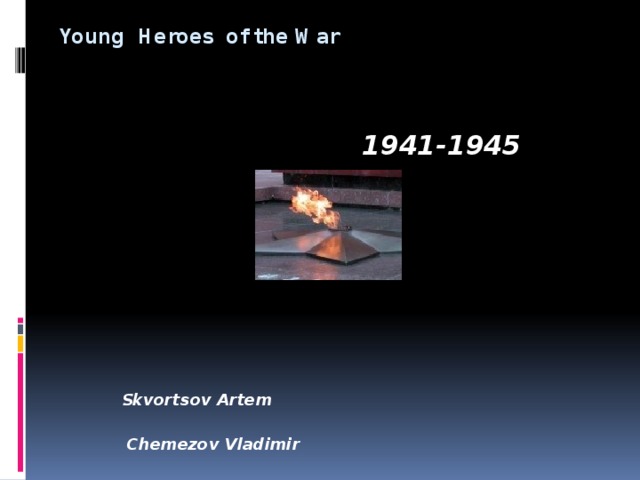
Young Heroes of the War
1941-1945
Skvortsov Artem
Chemezov Vladimir
School13 Kerch
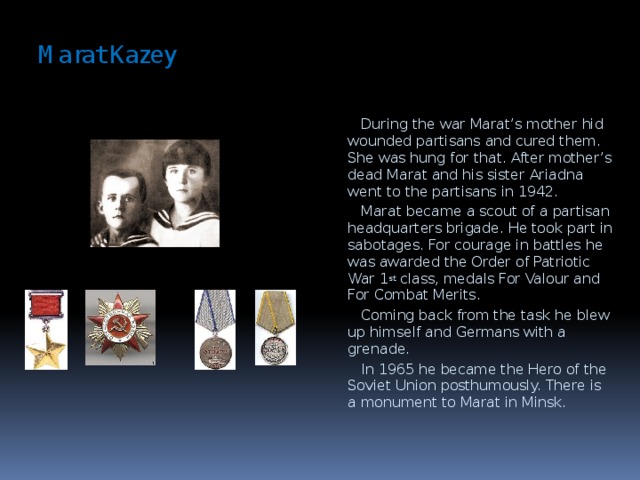
Marat Kazey
During the war Marat’s mother hid wounded partisans and cured them. She was hung for that. After mother’s dead Marat and his sister Ariadna went to the partisans in 1942.
Marat became a scout of a partisan headquarters brigade. He took part in sabotages. For courage in battles he was awarded the Order of Patriotic War 1 st class, medals For Valour and For Combat Merits.
Coming back from the task he blew up himself and Germans with a grenade.
In 1965 he became the Hero of the Soviet Union posthumously. There is a monument to Marat in Minsk.
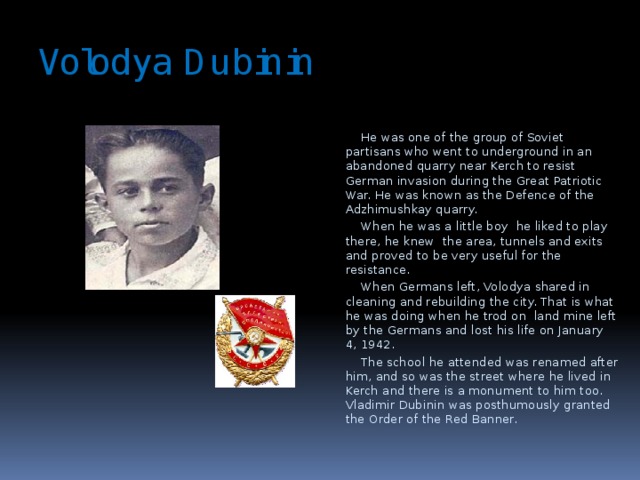
Volodya Dubinin
He was one of the group of Soviet partisans who went to underground in an abandoned quarry near Kerch to resist German invasion during the Great Patriotic War. He was known as the Defence of the Adzhimushkay quarry.
When he was a little boy he liked to play there, he knew the area, tunnels and exits and proved to be very useful for the resistance.
When Germans left, Volodya shared in cleaning and rebuilding the city. That is what he was doing when he trod on land mine left by the Germans and lost his life on January 4, 1942.
The school he attended was renamed after him, and so was the street where he lived in Kerch and there is a monument to him too. Vladimir Dubinin was posthumously granted the Order of the Red Banner.
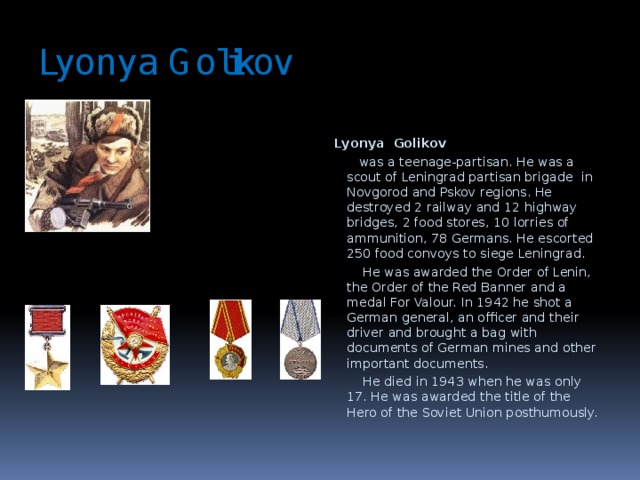
Lyonya Golikov
Lyonya Golikov
was a teenage-partisan. He was a scout of Leningrad partisan brigade in Novgorod and Pskov regions. He destroyed 2 railway and 12 highway bridges, 2 food stores, 10 lorries of ammunition, 78 Germans. He escorted 250 food convoys to siege Leningrad.
He was awarded the Order of Lenin, the Order of the Red Banner and a medal For Valour. In 1942 he shot a German general, an officer and their driver and brought a bag with documents of German mines and other important documents.
He died in 1943 when he was only 17. He was awarded the title of the Hero of the Soviet Union posthumously.
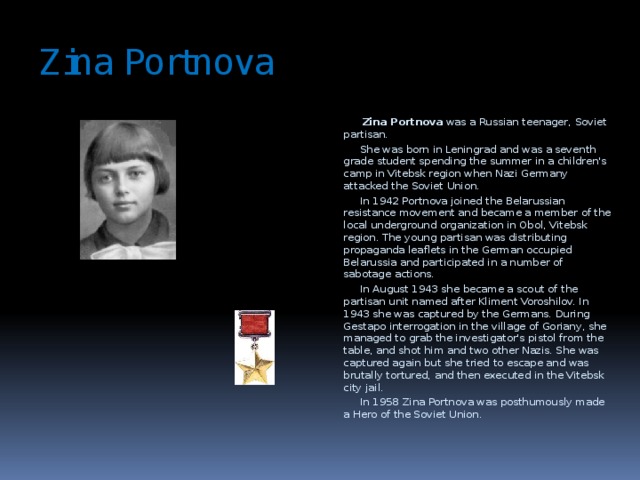
Zina Portnova
Zina Portnova was a Russian teenager, Soviet partisan.
She was born in Leningrad and was a seventh grade student spending the summer in a children's camp in Vitebsk region when Nazi Germany attacked the Soviet Union.
In 1942 Portnova joined the Belarussian resistance movement and became a member of the local underground organization in Obol, Vitebsk region. The young partisan was distributing propaganda leaflets in the German occupied Belarussia and participated in a number of sabotage actions.
In August 1943 she became a scout of the partisan unit named after Kliment Voroshilov. In 1943 she was captured by the Germans. During Gestapo interrogation in the village of Goriany, she managed to grab the investigator's pistol from the table, and shot him and two other Nazis. She was captured again but she tried to escape and was brutally tortured, and then executed in the Vitebsk city jail.
In 1958 Zina Portnova was posthumously made a Hero of the Soviet Union.

Вебинар для учителей

Свидетельство об участии БЕСПЛАТНО!