Узбекистан, Ташкент

СДЕЛАЙТЕ СВОИ УРОКИ ЕЩЁ ЭФФЕКТИВНЕЕ, А ЖИЗНЬ СВОБОДНЕЕ
Благодаря готовым учебным материалам для работы в классе и дистанционно
Скидки до 50 % на комплекты
только до
Готовые ключевые этапы урока всегда будут у вас под рукой
Организационный момент
Проверка знаний
Объяснение материала
Закрепление изученного
Итоги урока
Была в сети 26.05.2020 12:54

Саманова Зухра Озодовна
Учительница английского языка
42 года
 585
585
 97 132
Местоположение
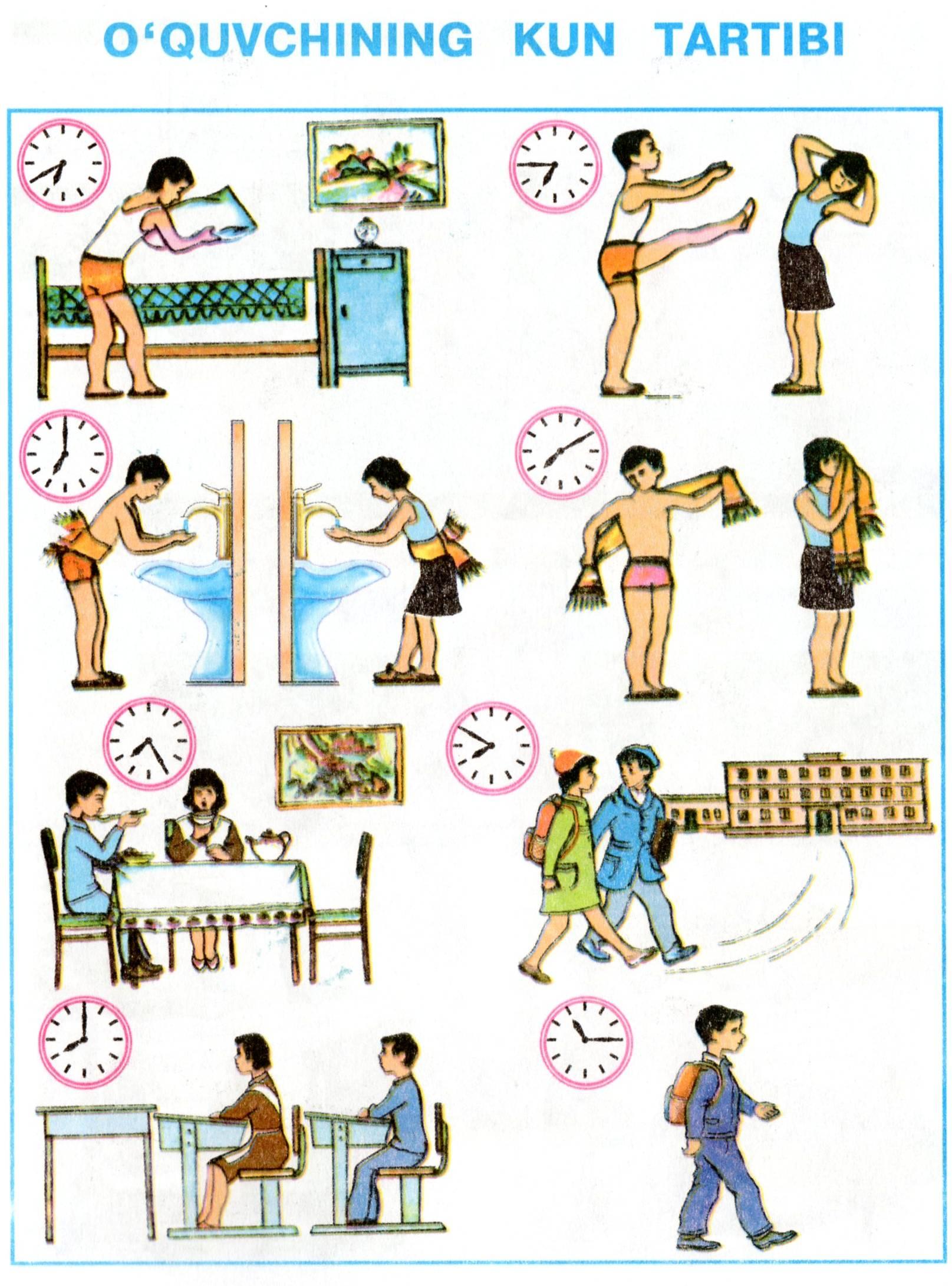
Theme: I make my bed
Категория:
Английский язык
20.05.2020 07:42

Просмотр содержимого документа
«Theme: I make my bed»
LESSON PLAN
School: 279
Teacher: Samanova Z.O
Unit 12. My day
Class:2nd grade
The theme: I make my bed
Aims:
Educational:
– to learn how to ask and answer
the questions using the words and
structures;
to learn to speak about daily routines;
–
 to consolidate the words on the
topic “Time”
Developing:
– to enable pupils to ask and answer
questions, listen, read and write
about daily routines;
– to enable pupils to say what they
do at particular parts of a day
Socio-cultural:
– to raise awareness of the pronunciation
of the sounds
Learning outcomes: By the end
of the lesson,
p upils will be
able to:
– say about
daily routines;
– say the activities
in the
morning before
they go
to school;
– use the
preposition at
with times;
The type of the lesson: oral, writing
The method of the lesson: unusual, mixed
Required equipment: Pupil’s book, Workbook, the DVD
|
| Technological map of the lesson | Time |
| 1 | Organizing moment | 2 |
| 2 | Warm-up | 3 |
| 3 | Remembering the last lesson | 3 |
| 4 | New theme | 25 |
| 5 | Chain drill | 3 |
| 6 | Game consolidation | 6 |
| 7 | Marking | 2 |
| 8 | Homework | 1 |
1. Organizational moment
Teacher: Good morning dear pupils
Pupils: Singing song “Good morning”
Good morning to you, good morning to you
Good morning dear teacher
Good morning to you
Teacher: Fine , thank you. Pupils , lets watch video clip and try to find our theme. What is our theme for today?
Pupils: “I make my bed”
Teacher: Yes our theme for today is “I make my bed”
Checking homework: (6 min) To revise the colors for.ex: black ,white, red brown and etc.
Now we shall divide into two group, first group is red ,second group is green
Warm up
Play the DVD. Ask the pupils to listen to the song “This is the
way we...” and sing along with the DVD.
DVD script
This is the way we wash our face, wash our face, wash our
face.
This is the way we wash our face so early in the morning.
This is the way we comb our hair, comb our hair, comb our
hair.
This is the way we comb our hair so early in the morning.
This is the way we brush our teeth, brush our teeth, brush
our teeth.
This is the way we brush our teeth so early in the morning.
Activity 1a Look, listen and repeat. Point and Say.
Objectives: to introduce the new words.
STEP 1: Tell the pupils that during Unit 7 they learned to say
what they do at a particular time of a day. Explain that today they
are going to get a little more specific. Ask the pupils to say in
their mother tongue what they usually do in the morning before
they go to school. Elicit the words in the mother tongue: make a
bed, do (my) morning exercises, wash (my) face and hands, get
dressed, comb (my) hair. Write the English equivalents next to
the elicited words.
STEP 2: Read the words one by one and ask the pupils to
repeat after you in chorus, in pairs and individually. Then say
the first word aloud and mime it. (Example: Mime combing your
hair and have the pupils guess and say the activity in the mother
tongue). After you get a satisfactory answer, draw the pupils’
attention to the English words on the blackboard or word cards
and have them guess pointing to each word. Ask the pupils to
pronounce in chorus, in pairs and individually.
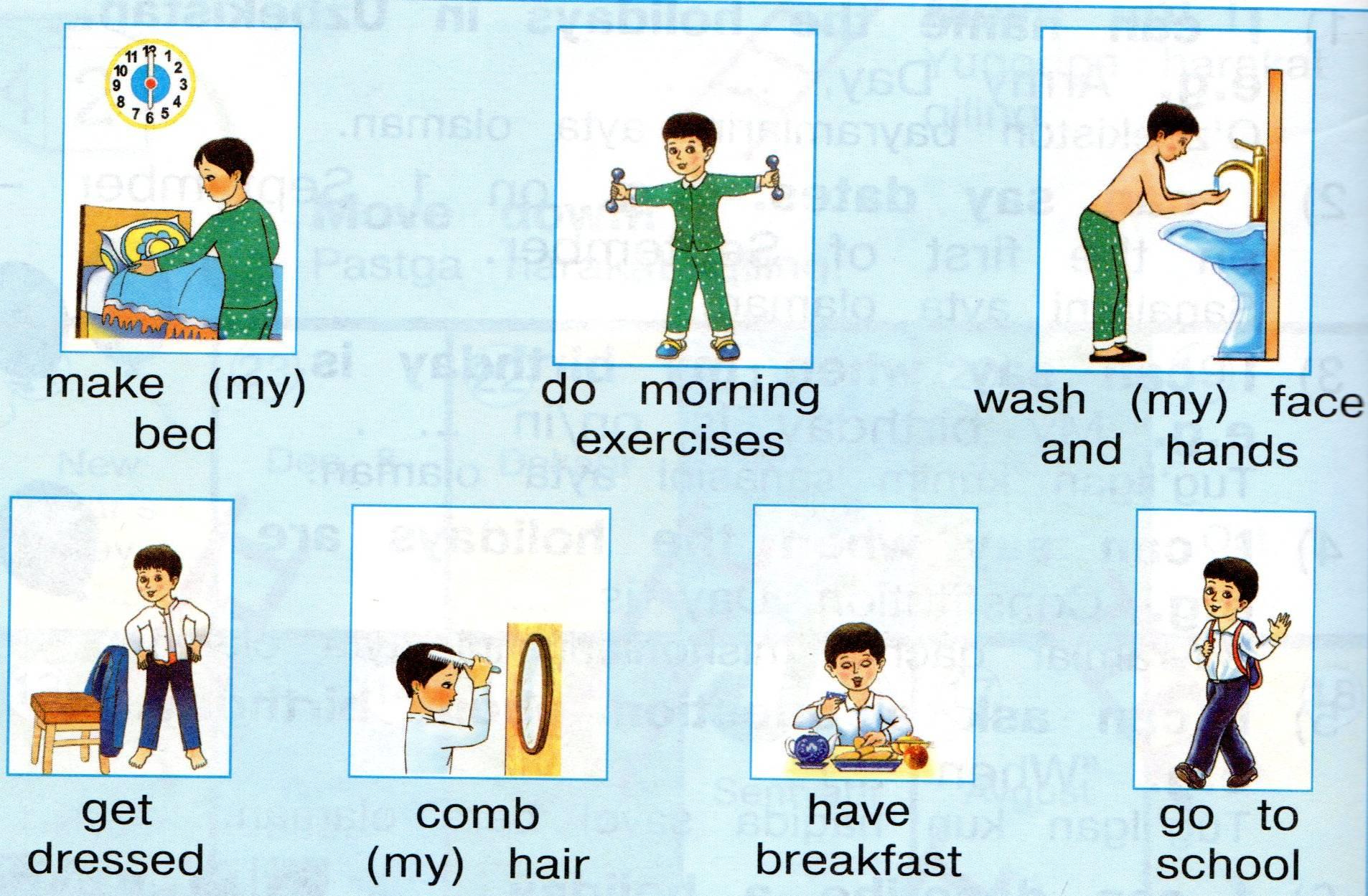
STEP 3: Play the DVD. The pupils watch the scenes first.
Then ask them to say what activities they can see in the mother
tongue. Play the DVD the second time having pupils repeat the
words and structures in chorus, in pairs and individually.
DVD: a scene of an early morning. Birds are singing. The
clock is pointing to 6.00. Then the following sentence is said: “I
get up in the morning.”; another scene where a boy is making his
bed, then the sentence is said: “I make my bed etc.
Activity 1b Work in pairs. Play “Miming”
Objectives: to reinforce the words and structures;
Pupil A mimes a verb in Activity 1a. Pupil B guesses and says
“I wash my hands in the morning.” Then they change roles.
Activity 1c Play “I do my morning exercises.”
Objectives: to reinforce the new words and pronouns (personal
and possessive)
STEP 1: Draw the pupils’ attention to the pronouns in the
tables. Have the pupils repeat them after you in chorus. After
that you can organise Chain Drill. Pupil A says “I”, Pupil B says
“my” and turns to the next pupil and says “you”, Pupil C says
“your” and turns to the next pupil and says “he”, etc.
STEP 2: Then ask them to look at the word combinations
with “my” in Activity 1a and say their definition in the mother
tongue. When you get a satisfactory answer, write them as a sentence
on the blackboard and underline the pronouns: “I make my
bed.” Explain that the pupils can change the personal pronoun
“I” and possessive “my” with the others from the table accordingly.
Let the pupils make sentences in turns as follows: “You
make your bed.”; “He makes his bed.”; “She makes her bed.” etc.
After that they can do the same with the other word combinations
in Activity 1a.
Activity 2 Look and write.
Objectives: to practise writing sentences with the new vocabulary
Ask the pupils to open their Workbooks and look at Activity
2. Explain that they must make sentences choosing a word from
each column as in the example. After that the pupils must translate
the sentences they have made to see if they make sense.
Activity 3 Work in pairs. Play “My day”
Objectives: to reinforce the words and structures;
Pupil A says a sentence using the word combinations from Activity
1a, for example “I wash my hands in the morning.”. Pupil
B mimes it. Then they change roles.
Marking: at the end of the lesson teacher gathers all of the marks then finds winner groups
Homework
Ask the pupils to open their Workbooks and look at the homework
activity. Explain that they must fill in the gaps using the
suitable pronouns from the table (Activity 1c) in their Pupil’s
book.
Answer key:
1. I make my bed.
2. She combs her hair
3. We wash our hands and face.
4. You do your morning exercises.

Вебинар для учителей
Свидетельство об участии БЕСПЛАТНО!