Казахстан, Атырау


СДЕЛАЙТЕ СВОИ УРОКИ ЕЩЁ ЭФФЕКТИВНЕЕ, А ЖИЗНЬ СВОБОДНЕЕ
Благодаря готовым учебным материалам для работы в классе и дистанционно
Скидки до 50 % на комплекты
только до
Готовые ключевые этапы урока всегда будут у вас под рукой
Организационный момент
Проверка знаний
Объяснение материала
Закрепление изученного
Итоги урока

Была в сети 09.01.2018 14:31

Акбулатова Даная Сырымовна
Преподаватель английского языка
35 лет
 5 976
5 976
 9 980
9 980 
Местоположение
Виды имен прилагательных
Категория:
Английский язык
06.12.2017 11:55

Просмотр содержимого документа
«Виды имен прилагательных»
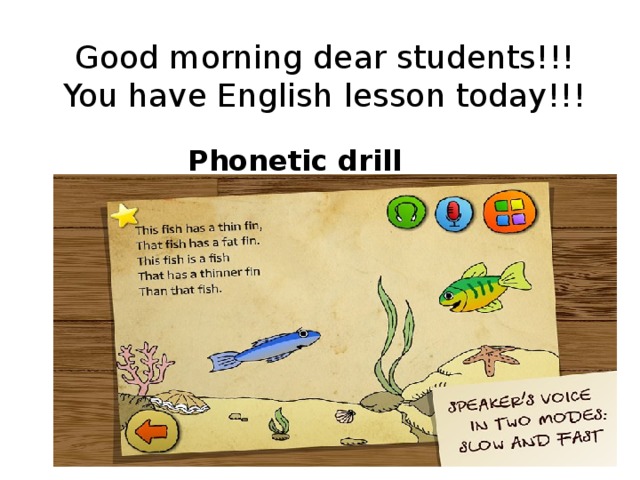
Good morning dear students!!! You have English lesson today!!!
Phonetic drill
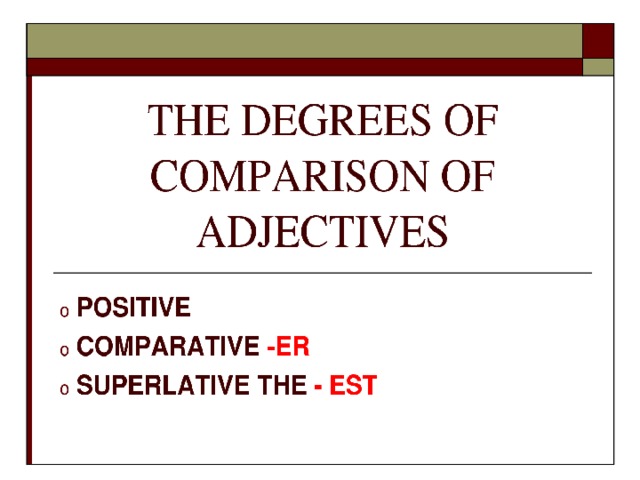
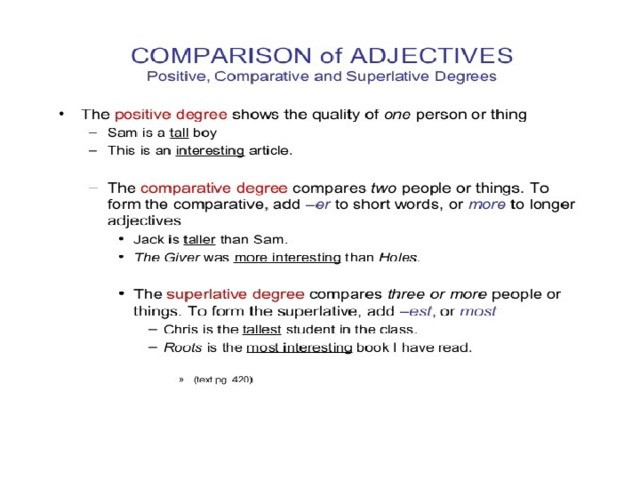
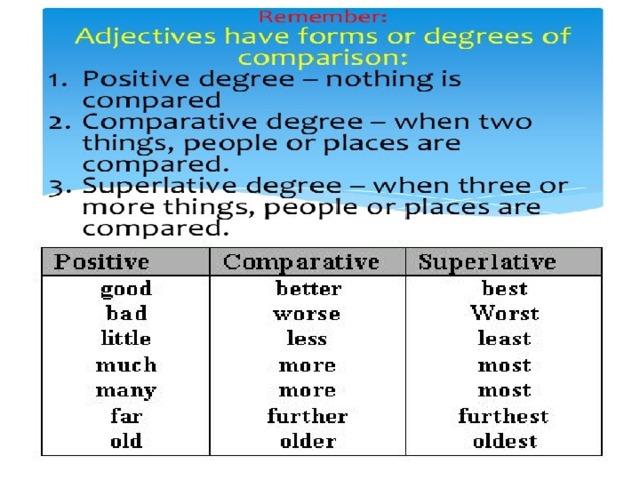
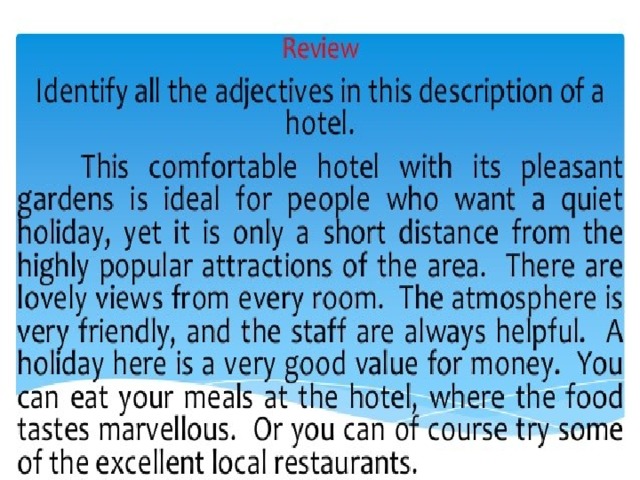
What is an adjectives?
Adjectives are words that describe or modify other words. They can identify or quantify another person or thing in the sentence. Adjectives are usually positioned before the noun or the pronoun that they modify.
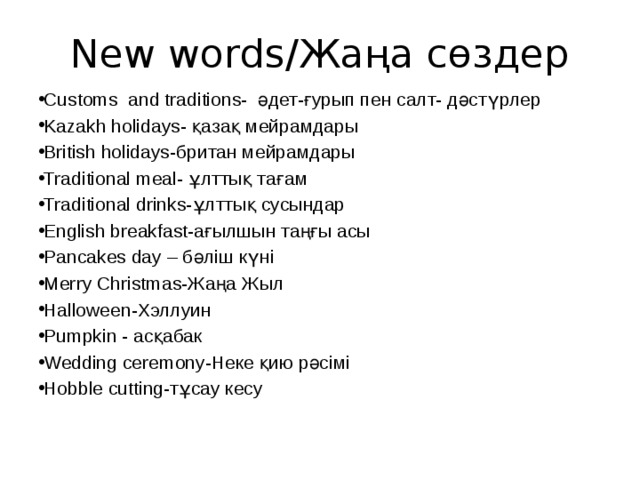
New words/Жаңа сөздер
- Customs and traditions- әдет-ғурып пен салт- дәстүрлер
- Kazakh holidays- қазақ мейрамдары
- British holidays-британ мейрамдары
- Traditional meal- ұлттық тағам
- Traditional drinks-ұлттық сусындар
- English breakfast-ағылшын таңғы асы
- Pancakes day – бәліш күні
- Merry Christmas-Жаңа Жыл
- Halloween-Хэллуин
- Pumpkin - асқабак
- Wedding ceremony-Неке қию рәсімі
- Hobble cutting-тұсау кесу
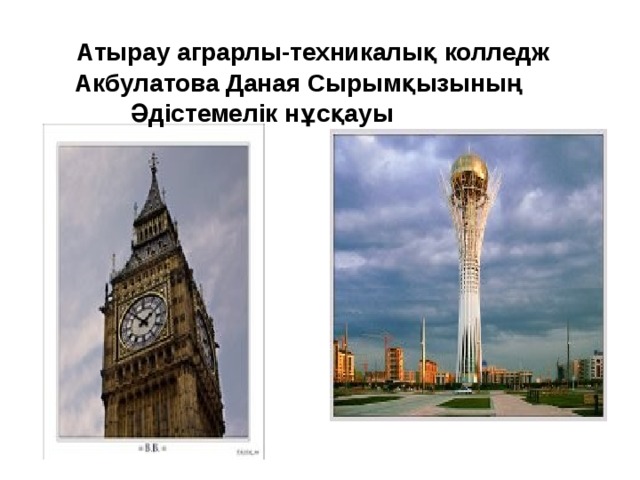
Атырау аграрлы-техникалық колледж
Акбулатова Даная Сырымқызының
Әдістемелік нұсқауы
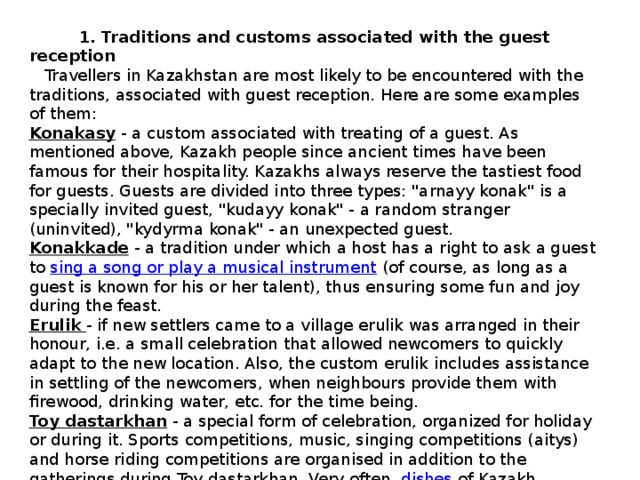
1. Traditions and customs associated with the guest reception
Travellers in Kazakhstan are most likely to be encountered with the traditions, associated with guest reception. Here are some examples of them:
Konakasy - a custom associated with treating of a guest. As mentioned above, Kazakh people since ancient times have been famous for their hospitality. Kazakhs always reserve the tastiest food for guests. Guests are divided into three types: "arnayy konak" is a specially invited guest, "kudayy konak" - a random stranger (uninvited), "kydyrma konak" - an unexpected guest.
Konakkade - a tradition under which a host has a right to ask a guest to sing a song or play a musical instrument (of course, as long as a guest is known for his or her talent), thus ensuring some fun and joy during the feast.
Erulik - if new settlers came to a village erulik was arranged in their honour, i.e. a small celebration that allowed newcomers to quickly adapt to the new location. Also, the custom erulik includes assistance in settling of the newcomers, when neighbours provide them with firewood, drinking water, etc. for the time being.
Toy dastarkhan - a special form of celebration, organized for holiday or during it. Sports competitions, music, singing competitions (aitys) and horse riding competitions are organised in addition to the gatherings during Toy dastarkhan. Very often, dishes of Kazakh national cuisine are served during such occasions.
2. Traditions and customs associated with gift giving
Suyіnshі - a custom according to which a traveller or any other person who brought home a good message (news) receives a valuable gift from the owners in gratitude. Sometimes before telling good news a person says ‘Suyunshi’ or ‘what would you give me for a Suyinshi?’, thus implying that he or she has something great to tell.
“ At mingizip shapan zhabu" is a high honour. According to the tradition, a respected visitor, who may be a poet (akin), a hero, warrior (batir) or other very respected man receives a gift from local residents: a horse and a splendid shapan (robe of camel's hair with a cotton lining) in recognition of their merit.
Baygazy - a tradition of giving a gift to a person, who acquired a new valuable thing.
3. Traditions and customs associated with mutual aid
Asar - a family, which has to perform an urgent and sometimes a hard work, has a right to ask relatives, friends and neighbours for assistance. At the end of the work, a rich table is laid as a gratitude for those, who helped.
Zhylu - a tradition associated with the provision of material, moral and financial assistance to people affected by natural disasters (fire, flood, etc.). All supporters, not only relatives are entitled to help the victims. Many things can be given as donations - livestock, building materials, clothing, money, etc.
Belkoterer - a tradition to treat the elderly. Delicious and most importantly - soft foods such as kazy, zhent, cottage cheese are cooked for the elderly. Typically, this responsibility rests on children or close relatives, the less likely neighbours. Belkoterer tradition is an example of caring for the elderly.
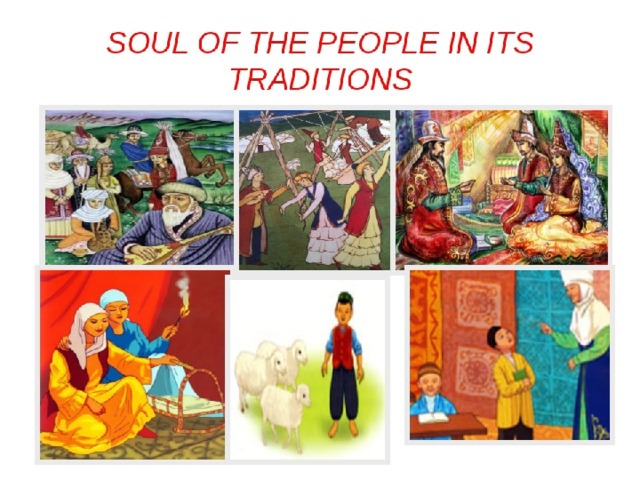
Every nation and every country has its own customs and traditions. Kazakh people have many national traditions, which are kept carefully and handed from generation to generation. What traditional customs of Kazakhs do you know? Just imagine that you have a foreign friend and he wants to know as much as possible about your country, about our customs and traditions.
The Kazakh people are rich in traditions. From birth through old age and death, every step of their lives has historically been marked with celebration. Even their funeral ceremonies have their own special symbolism. Unfortunately, many rich and interesting traditions and customs of the Kazakh people have been forgotten throughout the past century. Real sovereignty is just now being reestablished in Kazakhstan due to the process of democratization. These abandoned traditions are just now being rediscovered by the Kazakh people. These traditions include being respectful to old people; being patriotic to the motherland; being honest; and learning to love mankind.
What customs in KZ do you know?
- Wedding ceremony
- Betashar
- Hobbles cutting
- Kokpar
- Kyz kuu
- Altybakan
- Kazakh national drinks
- Kazakh national meals
- Kazakh national games
What customs in GB do you know?
- Children hang their socks and stockings for presents from Santa Claus.
- On Easter people dress new clothes it means the end of the bad weather season and the beginning of spring.
- On St. Patrick’s Day people dress green clothes, they make bright parades.
- On St. David’s Day people wear an emblem of England- the red rose.
- They have a Pancake’s races during Pancake week.
- They celebrate the Shakespeare’s birthday.
- They make flowers exhibitions.
4. Traditions and customs associated with birth and upbringing of the child
- Shіldehana - a celebration that is associated with childbirth.
- Besіkke salu, besik toy - a holiday, hosted when the newborn is put to a cradle - besik. As a rule, it is organized on the 3rd-5th day after dropout of umbilical cord of the kid.
- Kyrkynan shygaru – a ritual performed on the fortieth day after birth that includes bathing baby in 40 tablespoons of water, and the first haircut and nail cut and other rituals.
- Tusau kesu - a day when the baby took his first steps the oldest and most respected people is invited to perform a ceremony of Tusau keser. Then he or she should cut the special ropes, beset baby's legs, in order to ensure that in future the kid could walk nicely and run fast.
- Sundetke otyrgyzu is a rite of circumcision. The ceremony is held when a boy is 5-7 years old. A big festival to which all the relatives and friends are invited is organized after this. On the occasion of Sundetke otyrgyzu guests usually make generous gifts to the hero of the occasion and his parents.
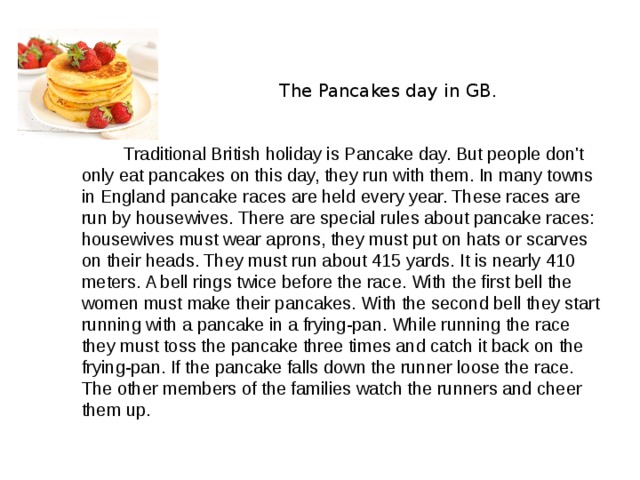
The Pancakes day in GB.
Traditional British holiday is Pancake day. But people don't only eat pancakes on this day, they run with them. In many towns in England pancake races are held every year. These races are run by housewives. There are special rules about pancake races: housewives must wear aprons, they must put on hats or scarves on their heads. They must run about 415 yards. It is nearly 410 meters. A bell rings twice before the race. With the first bell the women must make their pancakes. With the second bell they start running with a pancake in a frying-pan. While running the race they must toss the pancake three times and catch it back on the frying-pan. If the pancake falls down the runner loose the race. The other members of the families watch the runners and cheer them up.


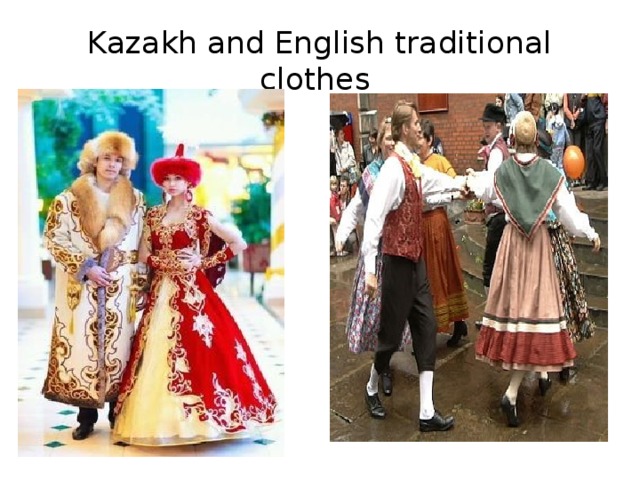
Kazakh and English traditional clothes
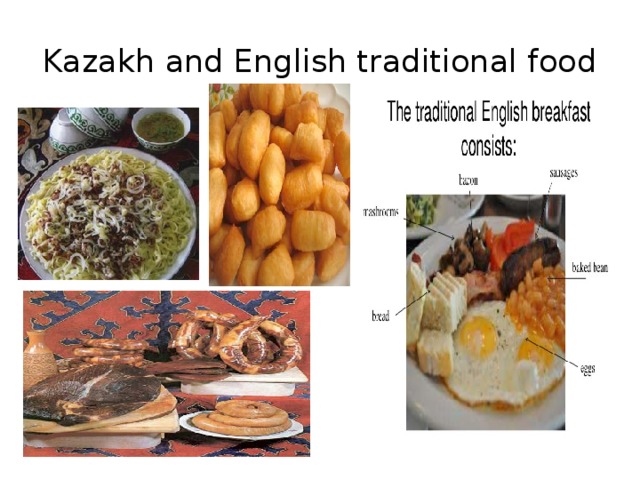
Kazakh and English traditional food
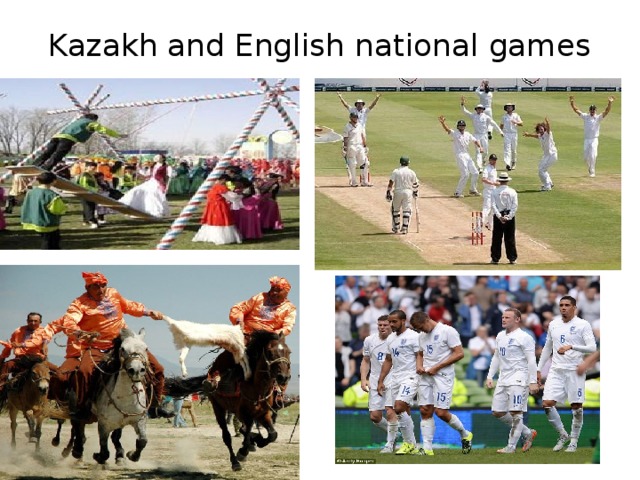
Kazakh and English national games
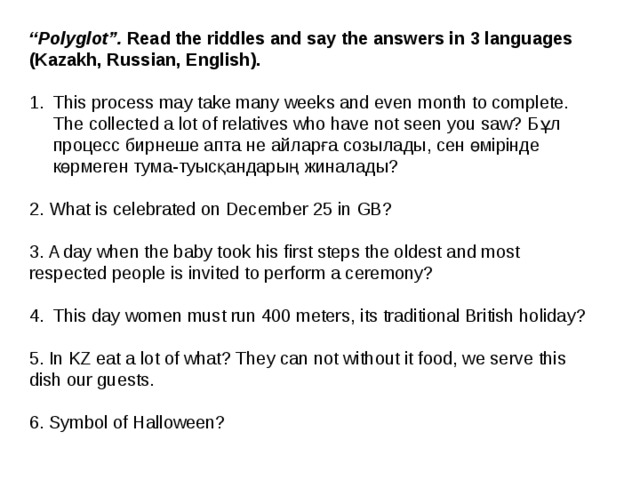
“ Polyglot”. Read the riddles and say the answers in 3 languages (Kazakh, Russian, English).
- This process may take many weeks and even month to complete. The collected a lot of relatives who have not seen you saw? Бұл процесс бирнеше апта не айларға созылады, сен өмірінде көрмеген тума-туысқандарың жиналады?
2. What is celebrated on December 25 in GB?
3. A day when the baby took his first steps the oldest and most respected people is invited to perform a ceremony?
- This day women must run 400 meters, its traditional British holiday?
5. In KZ eat a lot of what? They can not without it food, we serve this dish our guests.
6. Symbol of Halloween?
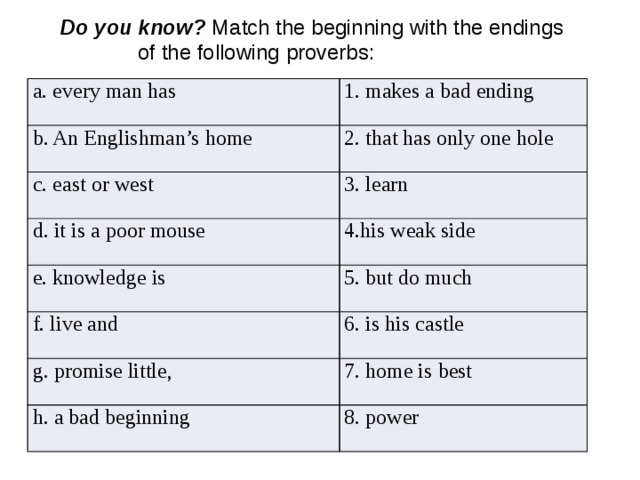
Do you know? Match the beginning with the endings
of the following proverbs:
a. every man has
1. makes a bad ending
b. An Englishman’s home
c. east or west
2. that has only one hole
d. it is a poor mouse
3. learn
4.his weak side
e. knowledge is
5. but do much
f. live and
6. is his castle
g. promise little,
7. home is best
h. a bad beginning
8. power
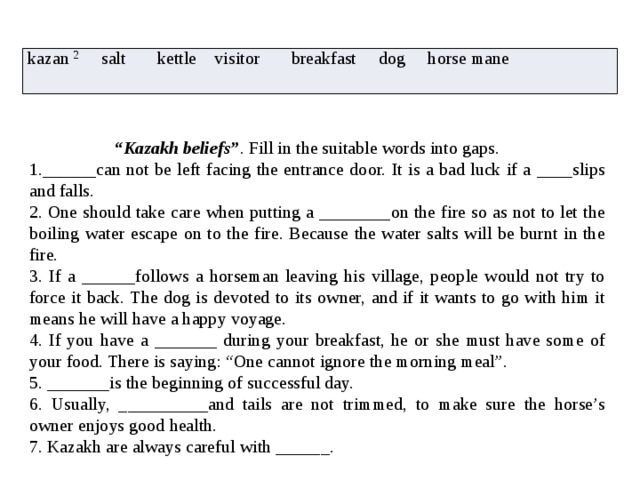
kazan 2 salt kettle visitor breakfast dog horse mane
“ Kazakh beliefs” . Fill in the suitable words into gaps.
1.______can not be left facing the entrance door. It is a bad luck if a ____slips and falls.
2. One should take care when putting a ________on the fire so as not to let the boiling water escape on to the fire. Because the water salts will be burnt in the fire.
3. If a ______follows a horseman leaving his village, people would not try to force it back. The dog is devoted to its owner, and if it wants to go with him it means he will have a happy voyage.
4. If you have a _______ during your breakfast, he or she must have some of your food. There is saying: “One cannot ignore the morning meal”.
5. _______is the beginning of successful day.
6. Usually, __________and tails are not trimmed, to make sure the horse’s owner enjoys good health.
7. Kazakh are always careful with ______.
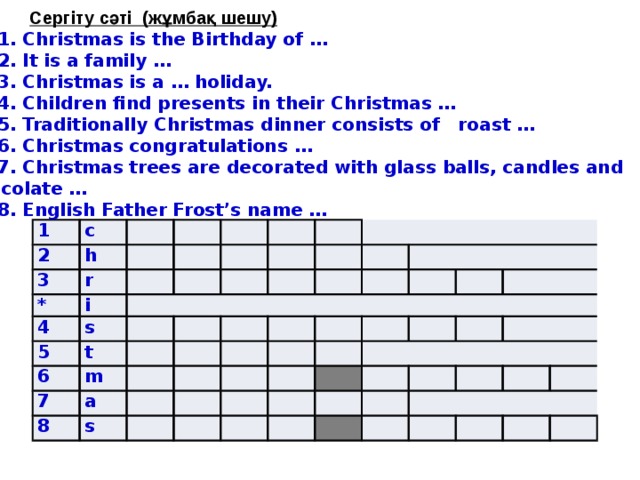
Сергіту сәті (жұмбақ шешу)
1. Christmas is the Birthday of …
2. It is a family …
3. Christmas is a … holiday.
4. Children find presents in their Christmas …
5. Traditionally Christmas dinner consists of roast …
6. Christmas congratulations …
7. Christmas trees are decorated with glass balls, candles and chocolate …
8. English Father Frost’s name …
1
2
c
3
h
*
r
4
i
s
5
6
t
7
m
a
8
s
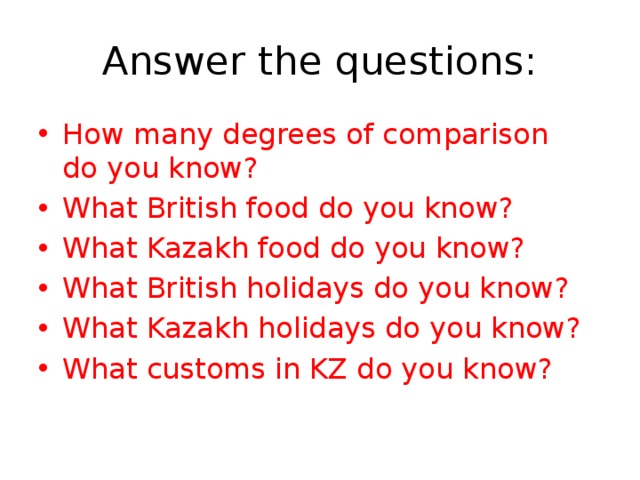
Answer the questions:
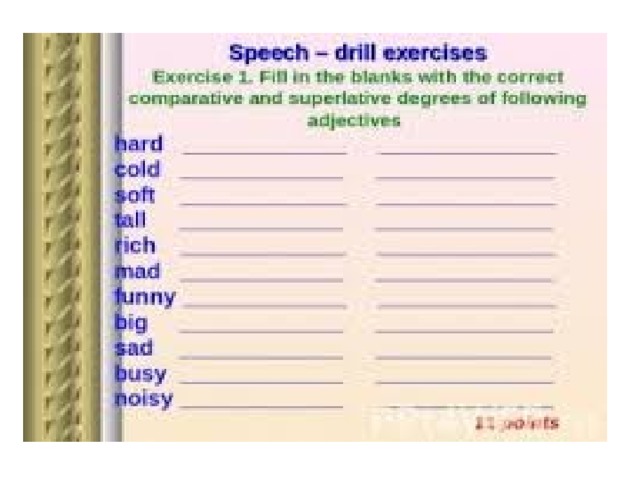
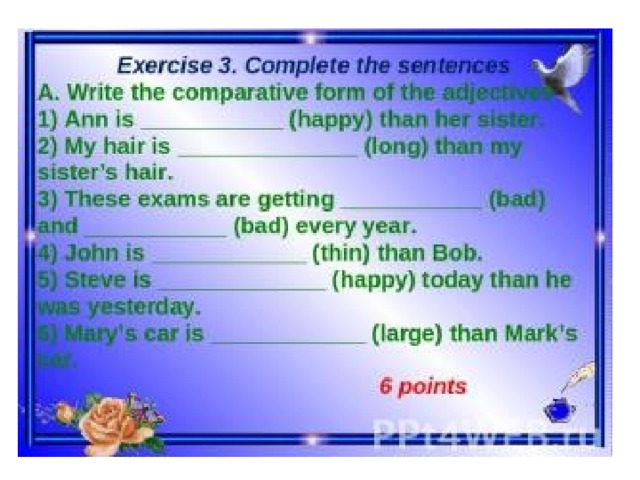
- How many degrees of comparison do you know?
- What British food do you know?
- What Kazakh food do you know?
- What British holidays do you know?
- What Kazakh holidays do you know?
- What customs in KZ do you know?
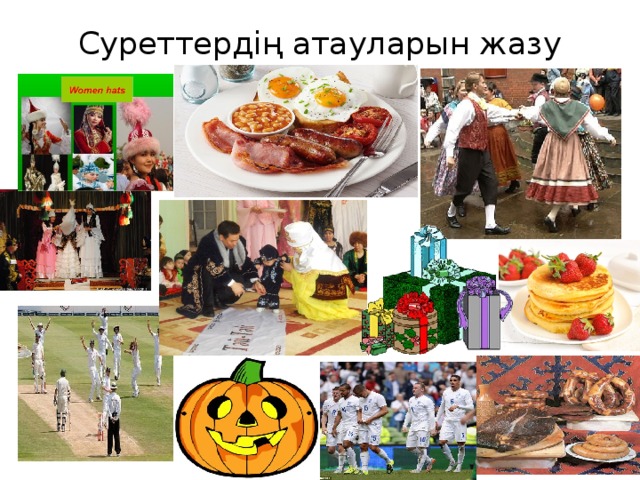
Суреттердің атауларын жазу
Вебинар для учителей

Свидетельство об участии БЕСПЛАТНО!